
Introduction
In industrial settings where heat, sparks, and flame exposure are routine, webbing must do more than hold weight—it must keep performing when standard materials would melt or fail. Fire retardant webbing is used in restraints, lifting assemblies, safety harnesses, curtains, and protective barriers where thermal resistance directly affects worker safety, equipment protection, and regulatory compliance. This article explains where it is used across industry, how it behaves under high temperatures, and which material and performance factors matter when selecting it for demanding applications.
Why Fire Retardant Webbing Matters in Industrial Applications
Industrial operations face constant thermal hazards, ranging from open flames and electrical arcs to extreme ambient heat. In these environments, the structural integrity of restraint and load-bearing systems is critical for safety. Standard synthetic textiles degrade rapidly under high temperatures, making specialized solutions necessary to prevent catastrophic failures.
The deployment of specialized textiles in high-risk zones is not merely a compliance measure; it is a fundamental engineering requirement. By utilizing materials designed to self-extinguish or resist ignition, facility managers and safety engineers can significantly extend the window of survivability during an emergency and protect high-value assets from secondary damage.
How it reduces operational risk
Operational risk mitigation relies heavily on material predictability under stress. Standard nylon or polyester webbing typically melts between 250°C and 260°C, losing all tensile strength and potentially dripping hazardous molten polymers onto workers or equipment. This sudden failure can lead to dropped loads, compromised fall protection, or accelerated fire spread.
By contrast, high-performance fire-retardant materials withstand intense thermal loads before charring, rather than melting. Some advanced aramid fibers maintain structural integrity at sustained temperatures up to 400°C to 500°C. This thermal stability ensures that harnesses, lifting slings, and cargo tie-downs continue to perform their mechanical duties even during active fire exposure, directly reducing the likelihood of fatal accidents and mitigating severe liability risks for industrial operators.
Industries that rely on it for safety
Sectors such as petrochemical refining, aerospace, metallurgy, and emergency response lean heavily on these specialized materials. In the oil and gas industry, where flash fires are a constant threat, workers rely on harnesses that will not melt into their uniforms. Similarly, the aerospace sector mandates strict flammability standards for cargo nets and seating components to prevent in-flight fire propagation.
Firefighting and tactical military operations also represent a massive demand center. Self-contained breathing apparatus (SCBA) straps and tactical extraction gear must endure direct flame impingement without compromising the wearer’s mobility or safety. For engineers and procurement specialists outfitting these industries, sourcing certified fire retardant webbing is a baseline requirement for operational readiness.
What Fire Retardant Webbing Is and How It Differs
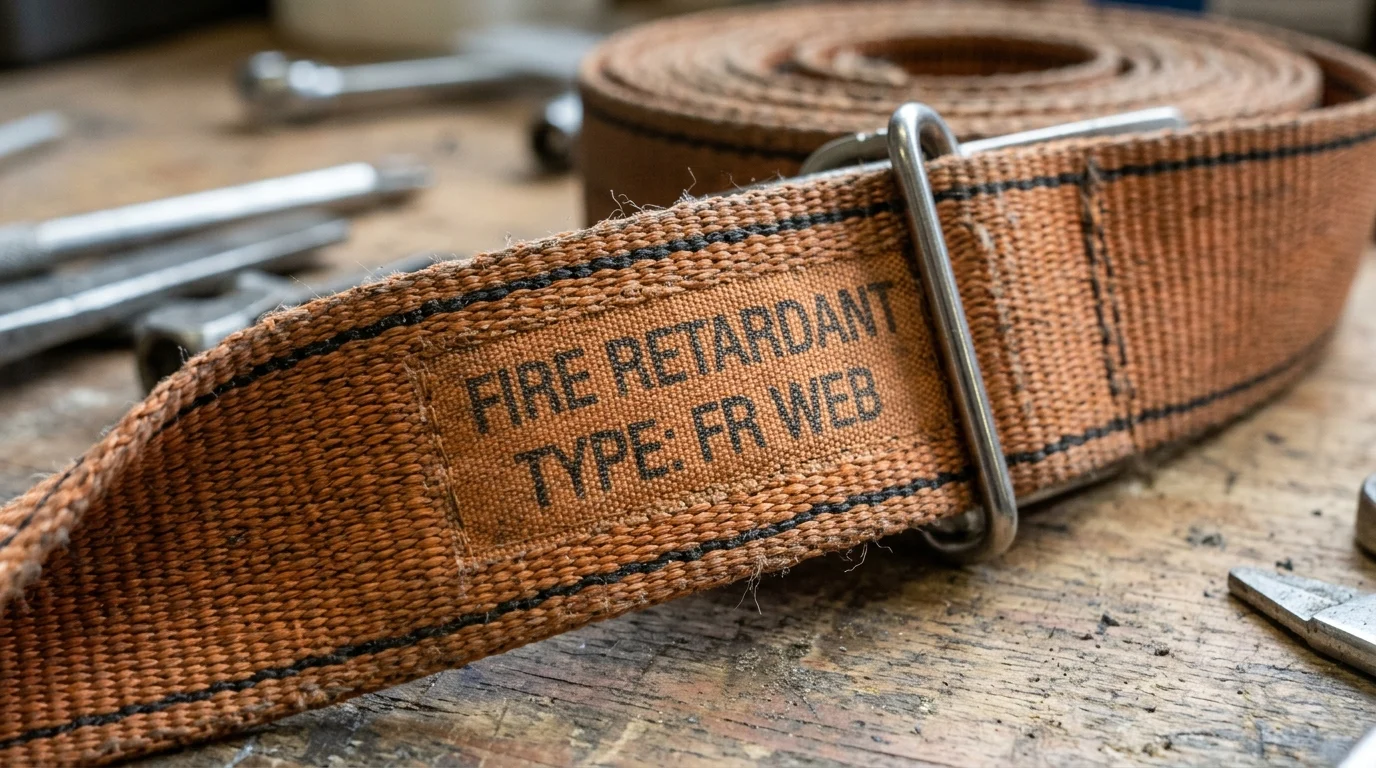
Understanding the chemical and structural composition of safety textiles is essential for proper specification. Not all materials marketed as flame-resistant operate under the same scientific principles, and their performance under mechanical stress varies significantly based on how the fire retardancy is achieved.
Fibers, coatings, and construction methods
Manufacturers primarily utilize two methodologies to produce these textiles: inherent flame resistance and chemical treatments. Inherent fibers, such as meta-aramids (e.g., Nomex) and para-aramids (e.g., Kevlar), possess a chemical structure that naturally resists ignition and does not melt. The protection is permanent and cannot be washed or worn away over the product’s lifespan.
Alternatively, standard synthetic fibers like polyester or nylon can be treated with topical chemical coatings to achieve fire retardancy. While this method is generally more cost-effective, the chemical barrier can degrade over time due to abrasion, UV exposure, and repeated laundering. The construction method—whether a flat weave for high abrasion resistance or a tubular weave for edge protection—also dictates how the fibers behave under dynamic loads.
Key performance factors
Performance is evaluated across a matrix of thermal limits, tensile strength, and abrasion resistance. A critical metric is the Minimum Breaking Strength (MBS). Depending on the width and fiber density, industrial-grade webbing can feature an MBS ranging from 5,000 lbs for standard fall protection up to 10,000 lbs or more for heavy cargo restraints.
Beyond pure strength, the Limiting Oxygen Index (LOI) is a vital quantitative factor. The LOI indicates the minimum concentration of oxygen required to support combustion. Standard polyester has an LOI of around 20-22%, making it flammable in normal atmospheric conditions (21% oxygen). In contrast, inherent aramid fibers boast an LOI of 28-30%, meaning they require an abnormally oxygen-rich environment to sustain a flame, effectively rendering them self-extinguishing in standard industrial settings.
How buyers should compare options
Procurement teams must weigh these variables against their specific operational requirements. High-heat environments with continuous friction demand different specifications than static cargo holds with stringent budget constraints. Comparing the core attributes of the dominant materials helps clarify the optimal choice.
| Material Type | Thermal Resistance Limit | Tensile Strength Retention | Cost Profile | Lifespan in Harsh Conditions |
|---|---|---|---|---|
| Para-Aramid (e.g., Kevlar) | Up to 500°C (chars, no melt) | Very High | High | Long (if UV protected) |
| Meta-Aramid (e.g., Nomex) | Up to 400°C (chars, no melt) | Moderate-High | Medium-High | Long |
| FR-Treated Polyester | ~260°C (melts, but self-extinguishes) | High | Low | Moderate (treatment degrades) |
| FR-Treated Nylon | ~250°C (melts, but self-extinguishes) | High (excellent stretch) | Low-Medium | Moderate (treatment degrades) |
Where Fire Retardant Webbing Is Used
The deployment of these specialized textiles spans multiple high-risk environments, each presenting unique mechanical and environmental challenges. Identifying the precise use case is necessary to match the textile’s physical properties with the demands of the application.
Personal protective equipment
In personal protective equipment (PPE), the primary goal is human life preservation under thermal stress. Fall protection harnesses used by welders or construction workers in petrochemical plants utilize inherently flame-resistant materials to ensure a sudden flash fire does not sever the lifeline. Similarly, the straps securing a firefighter’s oxygen tank must withstand ambient temperatures exceeding 300°C while supporting the heavy apparatus.
These PPE applications require strict adherence to ergonomic factors alongside thermal resistance. The webbing must remain flexible enough to conform to the body without causing chafing or fatigue, which often dictates the use of softer meta-aramid blends over stiffer para-aramids.
Transportation and industrial equipment
Heavy industry and transportation require robust restraint systems where thermal hazards intersect with massive kinetic loads. In the aerospace sector, cargo nets securing pallets inside aircraft holds must pass stringent vertical burn tests to prevent a localized lithium-ion battery fire from destroying the cargo restraint system. In these applications, webbing often requires a minimum breaking strength of 10,000 lbs per 2-inch width.
Electric vehicle (EV) manufacturing and logistics also heavily utilize these textiles. Securing high-voltage battery modules during transit requires non-conductive, fire-retardant tie-downs that can survive the intense, rapid heat generation characteristic of thermal runaway events in lithium batteries.
Environmental exposure factors
Beyond heat, environmental degradation plays a critical role in material selection. While para-aramids offer exceptional heat and cut resistance, they are notoriously sensitive to ultraviolet (UV) radiation. Uncoated aramid webbing can lose up to 50% of its tensile strength after just a few months of continuous exposure to direct sunlight.
Chemical exposure is another vital factor. Industrial environments frequently expose gear to hydraulic fluids, battery acids, and caustic cleaning agents. Polyester-based FR webbing resists acidic environments well but degrades in alkaline conditions, whereas nylon behaves inversely. Understanding these secondary exposure risks is essential to preventing premature material failure.
How to Assess Compliance, Testing, and Sourcing
Procuring safety-critical textiles requires strict adherence to regulatory frameworks and rigorous quality assurance protocols. Non-compliant materials deployed in hazardous environments do not merely fail; they invite catastrophic accidents, severe legal liabilities, and regulatory penalties.
Standards, testing, and certifications
Global safety standards dictate exacting testing protocols for flame resistance. In the aerospace sector, the FAA’s FAR 25.853 standard dictates vertical burn test requirements. To pass, the material must self-extinguish within 15 seconds after the removal of the flame source, and the char length must not exceed 8 inches.
For industrial PPE, standards such as NFPA 1971 (firefighting gear) and NFPA 2112 (flash fire protection) set the baseline for thermal shrinkage and heat transfer. Materials undergo oven testing at 260°C for five minutes; compliant webbing must not melt, drip, or separate, and thermal shrinkage is typically restricted to less than 10%. Buyers must verify these certifications through independent, third-party laboratory reports rather than relying solely on manufacturer claims.
Quality control and batch consistency
Consistent manufacturing is non-negotiable when human lives are at stake. A single weak point in a 100-meter spool can lead to a fatal harness failure. Quality control systems must align with ISO 9001 standards, ensuring full traceability from the raw fiber extrusion to the final woven product.
Leading manufacturers target a defect rate of less than 0.01% for life-safety textiles. This is achieved through automated optical inspection during the weaving process and destructive batch testing, where samples from every production lot are pulled and tested to failure on a tensile testing machine. Establishing a relationship with a transparent supplier—often vetted through their fire retardant webbing documentation and facility audits—is crucial for maintaining this level of quality assurance.
Sourcing trade-offs
Sourcing decisions involve balancing domestic supply chain security with global pricing models. While overseas manufacturing can reduce unit costs by 20% to 40%, it often introduces extended lead times (typically 8 to 12 weeks for specialized aramid weaves) and complicates quality auditing.
Conversely, domestic sourcing shortens supply chains and simplifies regulatory compliance, particularly for defense and aerospace contracts subject to the Berry Amendment or similar localized procurement laws. Buyers must calculate the hidden costs of delayed shipments and potential customs holds when evaluating international suppliers against domestic partners.
How to Choose the Right Fire Retardant Webbing
Finalizing a procurement strategy requires a structured approach that moves beyond basic specification matching. Engineers and purchasing managers must align the physical properties of the textile with the operational realities of the deployment environment, ensuring optimal safety without unnecessary over-engineering.
A step-by-step selection process
A systematic selection process minimizes the risk of specifying the wrong material. First, define the maximum thermal load and exposure duration. A flash fire requires different mitigation than sustained proximity to a blast furnace. Second, determine the precise mechanical requirements, including the Minimum Breaking Strength (MBS) and abrasion resistance needed for the application.
Third, assess the secondary environmental factors—such as UV exposure, moisture, and chemical contact—that will dictate the required coatings or fiber blends. The table below illustrates how these variables align in common industrial scenarios.
| Industrial Application | Recommended Fiber Profile | Minimum Breaking Strength (MBS) Target | Critical Regulatory Certification |
|---|---|---|---|
| Fall Protection (Welding) | Inherent Para-Aramid | 5,000 lbs (per OSHA) | ANSI Z359 / OSHA 1910 |
| Aerospace Cargo Restraint | FR-Treated Polyester | 10,000 lbs (heavy load) | FAA FAR 25.853 |
| Firefighter SCBA Straps | Inherent Meta-Aramid | 4,000 lbs | NFPA 1981 |
| EV Battery Tie-Downs | FR-Treated Nylon/Poly | 3,000 lbs | FMVSS 302 |
Balancing price, performance, and lifecycle cost
Financial models must account for the total cost of ownership rather than just the initial purchase price. Inherent aramid fibers often carry a cost multiplier of 3x to 5x compared to FR-treated polyester. However, in environments with heavy abrasion or frequent laundering, the chemical treatments on cheaper webbing will degrade, necessitating frequent replacement.
If a cheaper treated strap requires replacement every six months due to coating degradation, while an inherent aramid strap lasts three years, the higher upfront cost of the aramid yields a significantly lower lifecycle cost. Furthermore, the administrative burden of frequent safety inspections and replacements adds hidden labor costs. Consulting with technical specialists to audit your specific fire retardant webbing needs ensures that the chosen material balances uncompromising safety with long-term financial efficiency.
Further reading:
Key Takeaways
- The most important conclusions and rationale for fire retardant webbing
- Specs, compliance, and risk checks worth validating before you commit
- Practical next steps and caveats readers can apply immediately
Frequently Asked Questions
What is fire retardant webbing used for in industry?
It is used in harnesses, lifting slings, cargo tie-downs, SCBA straps, and safety restraints where heat or flame exposure could cause standard webbing to fail.
How is fire retardant webbing different from standard nylon or polyester webbing?
It resists ignition and chars instead of melting quickly. This helps maintain strength longer during heat exposure and reduces dripping molten material hazards.
Which industries commonly need fire retardant webbing?
Oil and gas, petrochemical plants, aerospace, metal processing, firefighting, and military operations commonly specify it for high-heat or flash-fire environments.
Should buyers choose inherent flame-resistant fibers or treated webbing?
Choose inherent aramid webbing for longer-lasting protection. Treated webbing can cost less, but its fire-retardant finish may wear down with abrasion, UV, or washing.
How can I evaluate fire retardant webbing suppliers on TramigoBlog’s product-focused guidance?
Check material type, temperature tolerance, MBS, weave construction, and relevant certifications. For sourcing, compare supplier product specs carefully to match your exact industrial risk.


