
Introduction
Choosing elastic bands for sportswear is less about finding the lowest-cost trim and more about matching material performance to garment use. The right band affects fit, comfort, durability, and how well a product holds its shape after repeated stretching, washing, and wear. This article explains what separates high-quality elastic from standard options, including stretch modulus, recovery, fiber composition, construction, and finishing. It also outlines how to evaluate suppliers, test samples, and align specifications with different sportswear categories, so you can source bands that meet both performance expectations and production requirements.
How to Source High-Quality Elastic Bands for Sportswear
Procuring trims for high-performance apparel requires meticulous attention to detail and rigorous engineering standards. Although trims—including elastic bands—often account for less than 5% of a garment's total Bill of Materials (BOM) cost, trim failures are responsible for up to 25% of consumer returns in the activewear sector. Selecting the correct elastic band dictates the lifespan, functionality, and consumer perception of the final garment.
In the competitive sportswear market, the demands placed on elastic components are extreme. They must withstand repeated cycles of high-tension stretching, exposure to harsh environmental factors, and industrial laundering without losing their structural integrity or aesthetic appeal.
Why fit, comfort, and recovery matter
The mechanical properties of elastic bands—specifically modulus and elongation—directly dictate garment functionality. Modulus refers to the force required to stretch the band to a specific percentage. A high-modulus elastic provides the firm, compressive support necessary for high-impact activities like running and high-intensity interval training (HIIT). Conversely, low-modulus variants prioritize comfort and flexibility, making them ideal for athleisure and yoga apparel.
Recovery—the band's ability to return to its original length after tension is released—is equally critical. Inferior recovery leads to "bagging out," a defect where waistbands or cuffs become permanently stretched. This renders the sportswear practically useless and severely damages brand reputation, often long before the primary knit or woven fabric shows signs of degradation.
Key sourcing risks to assess
Sourcing professionals must navigate several critical risks when procuring elastic components. Inconsistent elongation across production batches is a primary concern; a variance exceeding +/- 5% in stretch capacity can disrupt automated sewing lines, cause puckering, and alter the garment's final fit. Buyers must implement strict tolerance limits during the contracting phase to mitigate this risk.
Additionally, environmental degradation presents a major threat. Elastic bands exposed to human sweat, body oils, chlorine, and ultraviolet (UV) light will degrade rapidly—turning brittle or yellow—if the polymer core is not properly formulated or encased. Supply chain volatility, particularly regarding the availability of specialized elastane yarns, also threatens production timelines, necessitating dual-sourcing strategies for critical, high-volume trim components.
Technical Specifications That Define Quality
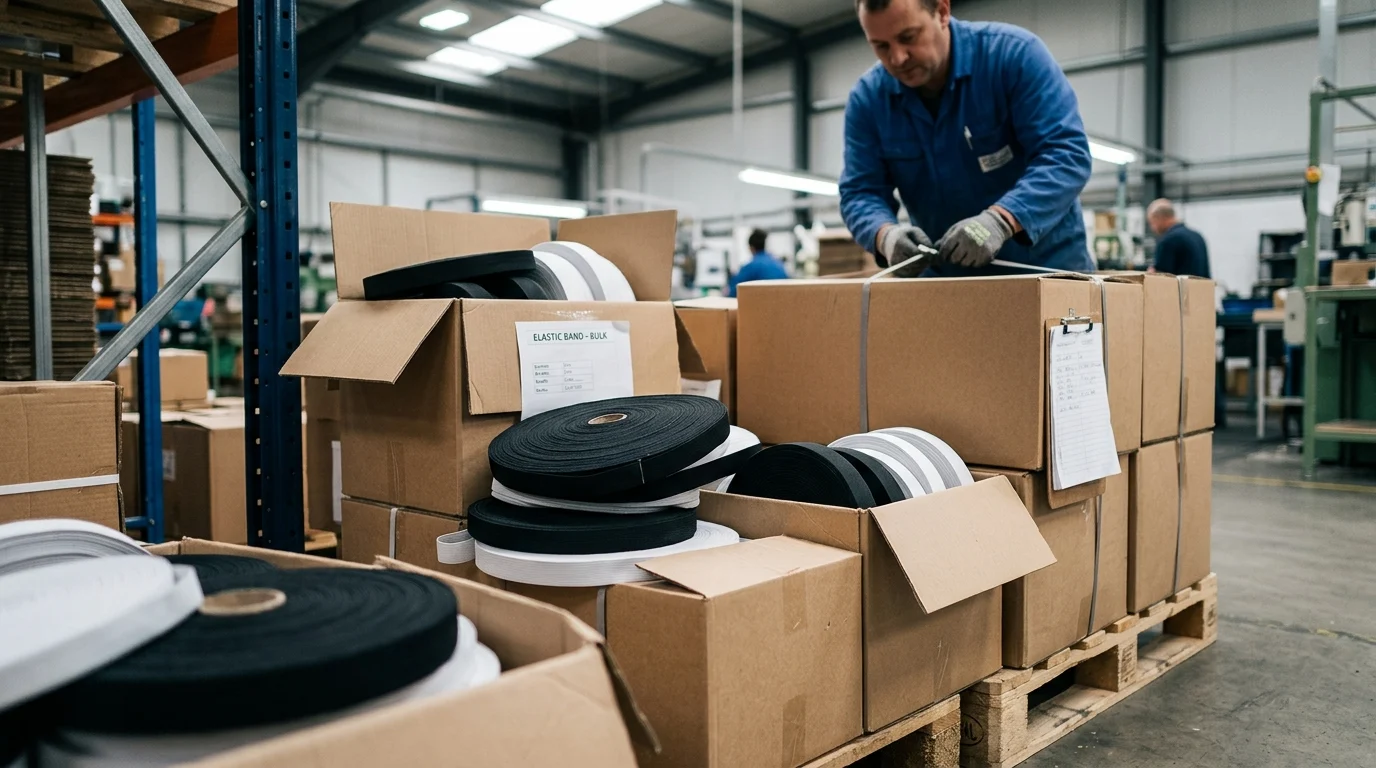
Establishing rigid technical specifications is the foundation of effective quality control and supplier alignment. Procurement teams cannot rely on subjective assessments of stretch or hand-feel; they must define exact parameters within their technical packages (tech packs) to ensure consistency across millions of units. Standard stretch requirements for activewear typically range from 100% to 150% elongation, with a mandatory recovery rate exceeding 95% within one minute of tension release.
Fiber composition, stretch, and recovery
The core of any elastic band is its elastomer, typically synthetic polyisoprene, natural rubber, or spandex (elastane). Spandex is overwhelmingly preferred in premium sportswear due to its superior resistance to oxidation, body oils, and chemical degradation. Natural rubber, while cost-effective, is prone to dry rot and cannot withstand the high temperatures of modern sublimation printing.
The casing yarn, which wraps the elastomeric core, dictates the band's interface with both the garment fabric and the wearer's skin. Micro-polyester provides excellent moisture-wicking properties and dye sublimation compatibility. Nylon offers superior abrasion resistance and a softer, cooler hand-feel against the skin. The specific denier of the casing yarn and the density of the weave or knit determine the band's final thickness, weight, and tactile properties.
Performance tests and comparison criteria
To validate quality, buyers must mandate specific laboratory testing protocols. Relying on internationally recognized standards ensures that the elastic will perform under the rigorous conditions of athletic use and repeated laundering.
| Test Standard | Parameter | Acceptable Sportswear Metric |
|---|---|---|
| ASTM D4964 | Elongation & Recovery | >95% recovery after 10,000 cycles |
| AATCC 16 | Colorfastness to Light | Grade 4.0 minimum |
| AATCC 162 | Colorfastness to Water (Chlorine) | Grade 4.0 minimum |
| ISO 6330 | Dimensional Stability (Shrinkage) | <3% after 5 wash cycles |
Procurement teams should require third-party laboratory reports for these metrics during the initial supplier onboarding phase and mandate random lot testing during mass production to ensure ongoing compliance.
Requirements by sportswear application
Specifications must be precisely tailored to the garment's end-use. Sports bras demand high-modulus, plush-backed elastics with an elongation restricted to 80–100% to ensure maximum motion control and structural support. The backing must be heavily brushed to prevent chafing during repetitive motion.
Conversely, waistbands for yoga leggings require a softer, low-modulus stretch—often engineered for 130–150% elongation—to prevent digging into the abdomen during complex movements and deep breathing. Swimwear elastics mandate specialized core materials, such as clear polyurethane tapes or highly treated spandex, designed specifically to withstand extreme, prolonged exposure to chlorine, saltwater, and sunscreen lotions without turning brittle or losing elasticity.
How to Evaluate Elastic Band Suppliers
A robust supplier matrix mitigates risk and ensures consistent product quality across global production runs. Evaluating elastic band manufacturers requires looking beyond quoted prices to assess their operational capabilities, quality management systems, and regulatory compliance. Industry data suggests that auditing suppliers thoroughly prior to contracting can reduce supply chain disruptions by an estimated 30% and drastically lower the incidence of failed garment lots.
Supplier due diligence checklist
Effective supplier due diligence begins with assessing production capacity and technological infrastructure. Buyers should verify the manufacturer's monthly output capacity—for example, a baseline requirement of 1 million meters per month for global brands—to ensure they can handle peak seasonal demand without unauthorized subcontracting.
Furthermore, the presence of an in-house testing laboratory equipped with tensile testing machines, colorimeters, and laundering facilities indicates a strong commitment to quality control. Equipment age and maintenance logs should also be reviewed during factory audits; older weaving, braiding, and knitting machines often struggle to maintain consistent tension, leading to unacceptable width and stretch variations in the final product.
Certifications and chemical compliance
Sportswear rests directly against the skin and is subjected to heavy perspiration, making chemical compliance a non-negotiable aspect of vendor evaluation. Suppliers must provide valid OEKO-TEX Standard 100 Class II (for direct skin contact) certifications. This guarantees that the elastic bands are free from harmful substances, including heavy metals, azo dyes, and phthalates.
For brands operating in or selling to the European Union, strict adherence to REACH regulations is legally mandatory. Procurement teams should require independent testing reports confirming that restricted substances are managed properly. For instance, formaldehyde levels must remain well below the strict 75 ppm threshold to prevent contact dermatitis and ensure consumer safety.
Comparing domestic, regional, and offshore options
Sourcing geography heavily influences landed cost, supply chain agility, and geopolitical risk. Brands must strategically weigh the advantages of high-volume offshore production against the speed and reliability of nearshoring.
| Sourcing Region | Typical MOQ | Average Lead Time | Cost Index | Specialty |
|---|---|---|---|---|
| Asia (China/Vietnam) | 10,000+ meters | 4-8 weeks | Low | High-volume, standard elastics |
| Central America (CAFTA) | 5,000 meters | 3-5 weeks | Medium | Nearshoring, duty-free benefits |
| Europe / North America | 1,000 meters | 2-4 weeks | High | Technical, custom Jacquard |
Asian suppliers generally offer the most competitive pricing for standard, high-volume items but require longer transit times. Nearshore options in Central America or Eastern Europe provide faster turnaround times and often benefit from duty-free trade agreements, making them ideal for responsive, fast-fashion activewear lines. Domestic suppliers are typically reserved for highly specialized, low-volume technical trims or rapid prototyping.
Purchasing Process for Reliable Supply at Scale
Transitioning from supplier selection to active purchasing requires rigid documentation and standardized operational processes. Procurement teams must establish clear Acceptable Quality Limits (AQL) prior to issuing purchase orders to prevent disputes upon delivery. In the sportswear trim sector, quality control protocols are typically set at AQL 1.5 for major defects—such as broken elastane cores, severe width deviations, or incorrect modulus—and AQL 4.0 for minor defects like slight color shading or packaging errors.
How to structure RFQs
A Request for Quotation (RFQ) for elastic bands must be exhaustive to eliminate assumptions. The RFQ should include detailed tech packs specifying the required width with strict tolerances (e.g., 25mm +/- 1mm), thickness, elongation percentage, and recovery rate. If sourcing Jacquard elastics with interwoven brand logos, the RFQ must include vector artwork files and specify the exact repeat length of the pattern.
Furthermore, buyers must dictate packaging requirements. Specifying whether the elastic should be tightly spooled on cardboard cores, loosely festooned in cartons, or pancake-rolled is critical. The chosen packaging method must perfectly align with the garment factory's automated feeding and cutting equipment to prevent tension issues during the sewing process.
Pilot orders, wear trials, and inspections
Before committing to high-volume bulk production, buyers must mandate pilot orders, typically ranging from 50 to 100 meters. These sample runs are crucial for conducting physical wear trials and wash tests. Garment technologists will sew the pilot elastic into prototype garments to evaluate its performance under sewing machine tension, its needle-cutting resistance, and its behavior during industrial laundering.
Third-party inspections, utilizing the established AQL standards, should be executed on the initial bulk run. This verifies that the mass-produced bands match the approved pilot samples in both mechanical performance and visual consistency, ensuring no unauthorized substitutions of cheaper elastane were made during scale-up.
Pricing, MOQs, and lead times
Negotiating pricing requires an understanding of the manufacturer's primary cost drivers: raw material commodity indexes (like polyester and spandex prices) and machine setup times. Minimum Order Quantities (MOQs) are heavily influenced by dyeing and setup requirements. Custom Pantone-matched elastics may require MOQs of 5,000 to 10,000 meters to justify the dye vat processing, whereas standard black or white bands might be readily available at MOQs as low as 1,000 meters.
Lead times vary according to customization. Standard greige goods that only require piece-dyeing might ship in two to three weeks. Conversely, custom Jacquard weaves require extensive machine programming, specialized yarn procurement, and slower weaving speeds, which can easily extend production lead times to six weeks or more before transit.
Decision Framework for Choosing the Best Supplier
The final sourcing decision relies on a structured, objective evaluation matrix rather than subjective preference or a singular focus on the lowest unit price. Leading procurement teams utilize weighted scoring models to quantify supplier capabilities and align them with the brand's overarching strategic objectives. A common, highly effective approach involves assigning a 40% weight to technical compliance and quality metrics, 30% to total landed cost, 20% to supply chain agility and lead times, and 10% to sustainability initiatives and chemical certifications.
Balancing performance, compliance, and supply continuity
Procurement professionals face constant trade-offs between performance specifications, regulatory compliance, and supply continuity. While an offshore supplier might offer a 15% reduction in unit cost, the extended transit times and increased risk of port delays might negate these savings through higher inventory carrying costs or expensive air freight requirements.
Furthermore, highly technical elastics—such as those requiring specialized silicone backing for grip in cycling shorts—may only be available from a limited pool of compliant suppliers. Balancing these factors requires a deep understanding of the product lifecycle, margin requirements, and the financial impact of stockouts versus premium freight charges.
Final selection criteria
Ultimately, the final selection criteria must focus on the Total Cost of Ownership (TCO). TCO accounts for the base unit price, inbound freight, customs duties, internal QA testing costs, defect rates, and the administrative burden of managing the supplier relationship.
The optimal supplier for sportswear elastic bands demonstrates not only the capability to meet stringent stretch and recovery specifications but also the organizational maturity to engage in Vendor Managed Inventory (VMI) programs and continuous improvement initiatives. By prioritizing TCO and unwavering technical reliability, brands ensure their sportswear delivers the precise fit, sustained comfort, and long-term durability that consumers demand.
Key Takeaways
- The most important conclusions and rationale for Elastic Bands
- Specs, compliance, and risk checks worth validating before you commit
- Practical next steps and caveats readers can apply immediately
Frequently Asked Questions
What stretch and recovery specs should elastic bands meet for sportswear?
Set elongation at 100%–150% and require over 95% recovery within one minute. This helps prevent bagging out and keeps fit consistent in activewear.
Which elastic band material is best for premium sportswear?
Spandex-based elastic is usually best. It resists body oils, oxidation, and chemicals better than natural rubber, making it more durable for sportswear use.
How can buyers reduce batch inconsistency when sourcing elastic bands?
Define strict tolerances in the tech pack, especially stretch variance within +/-5%. Also request approved lab reports and random lot testing during bulk production.
What tests should suppliers provide for sportswear elastic bands?
Ask for ASTM D4964 for elongation and recovery, AATCC 16 for light fastness, AATCC 162 for chlorine resistance, and ISO 6330 for shrinkage after washing.
Why do elastic bands fail early in activewear?
Early failures usually come from poor recovery or weak resistance to sweat, chlorine, UV, and laundering. Choosing the right polymer core and casing yarn reduces these risks.


