
Introduction
Bag webbing does far more than trim the design—it controls how a bag carries weight, resists wear, and responds to movement. The key choice is whether the webbing should stretch or stay rigid, because each option changes load stability, comfort, hardware support, and long-term durability. This guide explains where elastic webbing improves compression, flexibility, and shock absorption, and where non-stretch webbing is essential for structure and secure anchoring. By the end, you’ll be able to match webbing behavior to real bag functions and avoid material choices that lead to sagging, discomfort, or premature failure.
Why Stretch vs Non-Stretch Matters for Bag Webbing
In the design and manufacturing of specialized bags, backpacks, and luggage, webbing serves as the structural skeleton. While webbing typically accounts for only 5% to 10% of a bag's total Bill of Materials (BOM) cost, it is responsible for bearing up to 90% of the dynamic and static loads during operation. The fundamental engineering decision between utilizing stretch (elastic) or non-stretch (rigid) webbing dictates the product's durability, user comfort, and load-bearing capacity.
Choosing the incorrect webbing type can lead to catastrophic product failure, premature material fatigue, or severe user discomfort. Engineers must balance the necessity for rigid structural anchoring against the requirement for dynamic volumetric expansion, making the distinction between stretch and non-stretch webbing a critical determinant of a bag's market viability.
How webbing affects bag function
Webbing directly influences how a bag interacts with the human body and environmental forces. Non-stretch webbing provides absolute load stabilization, ensuring that heavy payloads do not shift the bag's center of gravity during transit. It acts as the primary anchor for hardware, such as buckles and D-rings, transferring the weight seamlessly across the bag's chassis.
Conversely, stretch webbing absorbs kinetic shock and enables compression. By allowing controlled elongation, elastic webbing accommodates varying volumes of cargo without requiring manual strap adjustments. This dynamic tension keeps external items secure against the bag's body, reducing sway and minimizing the kinetic energy transferred to the wearer.
Which bag types need different performance
The performance demands placed on webbing vary drastically across bag categories. Heavy-duty tactical backpacks and mountaineering packs require non-stretch webbing, particularly for MOLLE (Modular Lightweight Load-carrying Equipment) systems. These applications demand webbing capable of supporting static loads exceeding 50 pounds without yielding, ensuring that attached pouches remain perfectly aligned.
In contrast, athletic bags, running hydration vests, and cycling packs rely heavily on stretch webbing. These applications require materials capable of 120% to 150% elongation to expand and contract with the wearer's respiratory movements. Using rigid webbing in a hydration vest would restrict breathing, whereas using elastic webbing for a mountaineering load-lifter strap would completely negate weight distribution.
What Defines Stretch and Non-Stretch Webbing
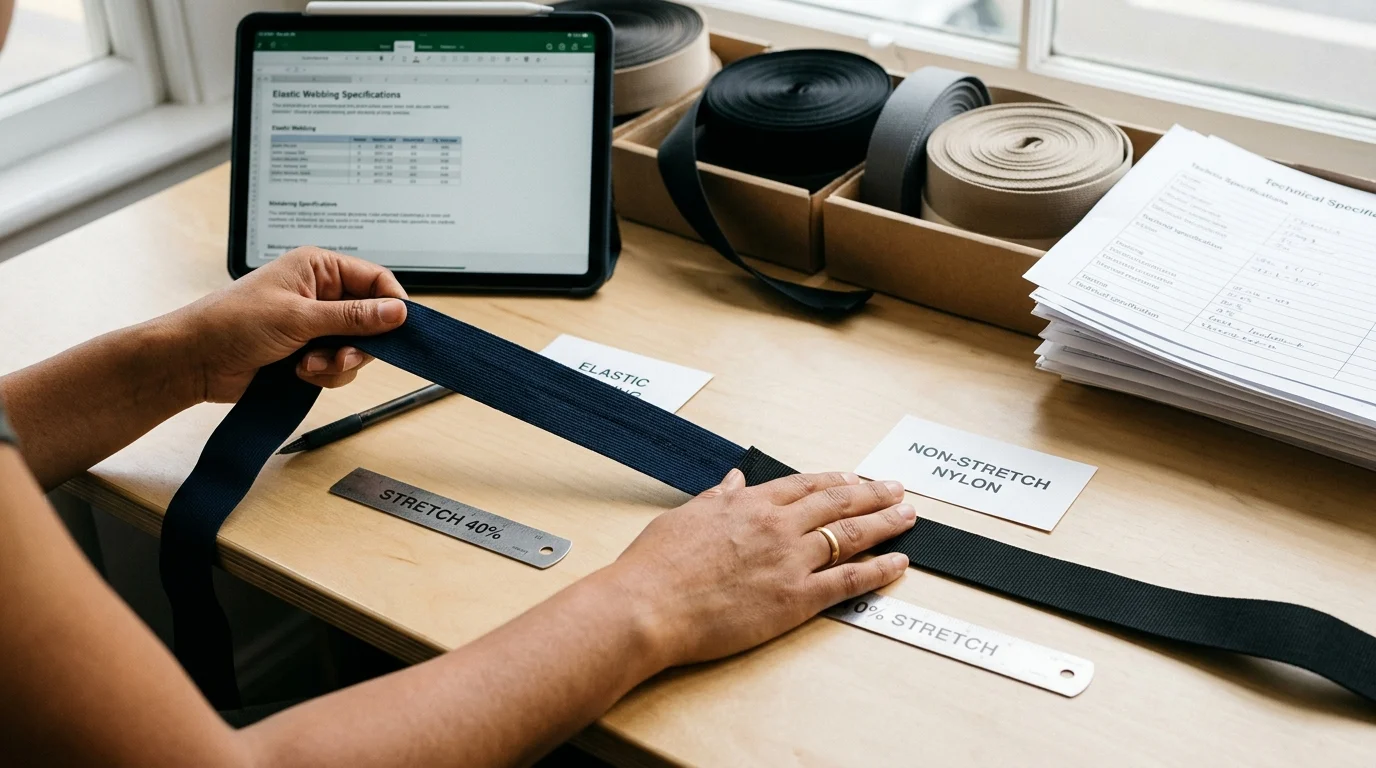
The physical distinction between stretch and non-stretch webbing originates at the polymer level. Understanding the raw materials, weave structures, and resulting mechanical properties is essential for procurement teams to match component specifications with end-use requirements.
How materials and construction differ
Non-stretch webbing is entirely composed of rigid synthetic polymers, most commonly nylon, polyester, or polypropylene. These yarns are woven tightly in flat or tubular configurations using high-denier fibers (typically ranging from 500D to 1000D). The dense weave structure is designed to maximize tensile strength and resist abrasion.
Stretch webbing incorporates an elastomeric core—usually spandex (elastane) or natural rubber—wrapped in a synthetic sheath. The rigid synthetic fibers protect the vulnerable elastic core from UV degradation and abrasion while defining the maximum stretch limit. The weaving process for elastic webbing is highly specialized, requiring precise tension control to ensure the elastomer does not snap or warp during manufacturing.
How to compare key webbing specifications
When comparing webbing specifications, engineers focus on tensile strength, maximum elongation, and environmental resistances. A standard 1-inch non-stretch nylon webbing can exhibit a tensile strength of up to 4,000 pounds, making it suitable for life-safety and heavy cargo applications. A 1-inch elastic webbing, however, may only support 15 to 50 pounds before reaching critical deformation.
| Material Type | Typical Tensile Strength (1-inch width) | Standard Elongation Limit | UV Resistance | Abrasion Resistance |
|---|---|---|---|---|
| Nylon (Non-Stretch) | 3,000 – 4,000 lbs | < 2% | Moderate | Very High |
| Polyester (Non-Stretch) | 1,500 – 2,500 lbs | < 1% | High | High |
| Polypropylene (Non-Stretch) | 600 – 900 lbs | < 5% | Low | Moderate |
| Spandex/Nylon (Stretch) | 15 – 50 lbs | 100% – 150% | Moderate | Low to Moderate |
This comparative matrix demonstrates why polyester is frequently chosen for outdoor bags requiring high UV resistance, while nylon dominates high-abrasion tactical gear.
What the main performance differences are
The primary performance difference lies in the material's response to continuous mechanical stress. Non-stretch webbing excels in static tensile strength and abrasion resistance but offers zero shock absorption. Over time, rigid webbing can fray if subjected to sharp hardware edges but will not lose its structural length.
Elastic webbing is defined by its recovery rate—the ability to return to its original length after elongation. High-quality stretch webbing must maintain at least a 95% recovery rate after 10,000 stretch cycles. However, elastic components are highly susceptible to chemical degradation, extreme heat, and long-term fatigue, often losing their retentive properties years before the rigid components of the bag fail.
How to Evaluate Webbing for Bag Applications
Evaluating webbing requires a rigorous alignment of material capabilities with the bag's intended operational environment. Sourcing managers must assess not only the theoretical specifications but also how the webbing will perform under real-world multi-axis stress.
When stretch webbing is the better choice
Stretch webbing is the optimal choice for external cargo retention systems, expanding side pockets, and dynamic sternum straps. In these applications, the webbing must secure irregularly shaped items, such as water bottles or helmets, by applying continuous inward pressure.
For sternum straps specifically, utilizing a 1/2-inch to 3/4-inch elastic webbing with a controlled 20% to 30% stretch capacity allows the strap to secure the shoulder pads without restricting the user's chest expansion. Stretch webbing is also highly effective in internal organization panels, where loops are needed to grip tools, pens, or medical supplies tightly regardless of their exact diameter.
When non-stretch webbing is the safer option
Non-stretch webbing is mandatory for any structural or safety-critical zone on a bag. This includes shoulder strap anchors, waist belt stabilizers, load lifters, and primary closure straps. In these areas, the webbing must maintain absolute dimensional stability.
For example, a load lifter strap on a 65-liter expedition backpack must not elongate. If the webbing stretches even 2% under a 100-pound load, it compromises the user's center of gravity and renders the suspension system ineffective. Non-stretch webbing is also required wherever specialized hardware, such as cam buckles or tension locks, is utilized, as these mechanisms rely on friction against a rigid surface to prevent slippage.
Which tests and quality checks matter
Quality assurance for bag webbing relies on standardized laboratory testing. For non-stretch webbing, the ASTM D6770 standard is frequently used to measure abrasion resistance, while tensile strength is verified using Universal Testing Machines (UTM).
For stretch webbing, ASTM D4964 is the critical standard for evaluating elongation and recovery under tension. Manufacturers should demand test reports proving the elastomer's resistance to ozone and UV exposure, which rapidly degrade rubber. In mass production, strict quality control limits must be enforced; premium bag manufacturers typically reject batches if the defect rate (such as dropped stitches or exposed core threads) exceeds 1.5% per 1,000 yards.
What Cost and Sourcing Factors Affect Webbing Choice
Procurement strategies for bag webbing must balance technical performance against volatile raw material costs and global supply chain logistics. The choice between standard rigid polymers and specialized elastomeric blends significantly impacts the final unit economics of the bag.
How materials and customization affect cost
The raw materials and the complexity of the manufacturing process heavily dictate pricing. Standard non-stretch polypropylene is highly economical, whereas custom Jacquard-woven elastic webbing with branded logos requires specialized looms and high-grade elastane, driving up costs exponentially.
| Webbing Category | Estimated Cost per Yard | Typical Minimum Order Quantity (MOQ) | Primary Cost Driver |
|---|---|---|---|
| Standard Polypropylene | $0.05 – $0.12 | 1,000 – 3,000 yds | Resin commodity prices |
| Standard Nylon (Non-Stretch) | $0.15 – $0.25 | 3,000 – 5,000 yds | Dyeing and finishing processes |
| Basic Elastic (Polyester blend) | $0.30 – $0.45 | 3,000 – 5,000 yds | Elastomer quality |
| Custom Jacquard Elastic | $0.80 – $1.20+ | 5,000 – 10,000 yds | Loom setup and tooling time |
Custom color matching (Pantone dyeing) or adding treatments such as Durable Water Repellent (DWR) or infrared (IR) compliance for military applications can add $0.10 to $0.30 per yard.
How to assess supplier reliability
Assessing supplier reliability goes beyond comparing price per yard. Buyers must verify that the webbing manufacturer holds relevant certifications, such as ISO 9001 for quality management and OEKO-TEX Standard 100 if the webbing will have prolonged skin contact (common in athletic bags).
A reliable supplier will maintain robust in-house testing facilities. Buyers should audit the supplier's ability to provide batch-specific Certificate of Analysis (CoA) documents detailing tensile strength and colorfastness. Suppliers who outsource their dyeing processes often suffer from higher color variance between batches, which can ruin the aesthetic consistency of a premium bag.
What production and shipping factors to review
Lead times and freight considerations play a major role in webbing procurement. Standard stock colors (black, olive drab, coyote brown) from major textile hubs typically carry lead times of 3 to 5 weeks. However, custom dye lots or specialized stretch webbings frequently require 6 to 8 weeks for production.
Webbing is heavy and dense, usually shipped in rolls of 50 or 100 yards. Buyers must calculate container utilization carefully; air-freighting a delayed batch of heavy 1000D nylon webbing can entirely erase the profit margin of a production run. Consolidating webbing suppliers geographically close to the final bag assembly factory is a standard industry practice to mitigate logistics risks.
How Buyers Can Choose the Right Webbing
Synthesizing the technical, environmental, and commercial variables into a final procurement decision requires a structured approach. Buyers must ensure that the chosen webbing aligns perfectly with the bag's intended lifecycle and target retail price.
What step-by-step selection process to use
An effective selection process follows a strict sequence to eliminate unsuitable materials early. First, define the absolute load parameters in kilograms or pounds; if the component must bear structural weight, stretch webbing is immediately disqualified. Second, map the environmental exposure. If the bag will see heavy marine or UV exposure, polyester must be prioritized over nylon.
Third, specify the exact stretch percentage required—ranging from 0% for structural straps to 150% for dynamic retention. Fourth, calculate the target component cost within the broader BOM. Finally, request physical samples and mandate that the factory assemble a prototype bag to test hardware compatibility, as webbing thickness (ranging from 0.03 to 0.08 inches) drastically affects how smoothly it passes through buckles.
Which final criteria should guide the decision
The ultimate decision should be guided by the Total Cost of Ownership (TCO) and warranty liability rather than raw material costs alone. A failure in a $0.20 webbing component can render a $200 technical backpack useless, triggering costly warranty claims and brand damage.
Buyers must evaluate end-user expectations regarding longevity. While an aggressive 150% stretch webbing might offer excellent initial functionality for a running pack, if its recovery rate degrades after six months of UV exposure, it fails the consumer. Choosing the right webbing requires prioritizing long-term mechanical stability, ensuring the straps outlast the fabric body of the bag itself.
Key Takeaways
- The most important conclusions and rationale for Elastic Webbing for Bags
- Specs, compliance, and risk checks worth validating before you commit
- Practical next steps and caveats readers can apply immediately
Frequently Asked Questions
When should I choose stretch webbing for a bag?
Use stretch webbing for compression pockets, bottle holders, running vests, and gear retention where controlled expansion and shock absorption improve comfort and fit.
When is non-stretch webbing the better option?
Choose non-stretch webbing for shoulder straps, load lifters, handles, MOLLE panels, and buckle anchor points where stability and high tensile strength are critical.
How much weight can elastic webbing usually handle?
A 1-inch elastic webbing typically supports about 15 to 50 pounds before critical deformation, so it is not suitable for primary load-bearing straps.
Which non-stretch webbing material is best for outdoor bags?
Polyester is often best for outdoor bags with strong sun exposure because it offers high UV resistance while maintaining good strength and durability.
Can I mix stretch and non-stretch webbing in one bag design?
Yes. Use non-stretch webbing for structural support and hardware attachment, and add stretch webbing only where you need flexible storage or compression.


