
Introduction
Elastic webbing does far more than hold a garment together in sportswear manufacturing: it controls stretch, recovery, support, and long-term comfort in waistbands, straps, cuffs, and compression zones. Choosing the right type affects how well a product fits during movement, how it performs after repeated washing, and how durable it feels to the customer. This article explains where elastic webbing is used, which performance factors matter most, and how manufacturers can match material, construction, and application method to the demands of different sportswear products.
How Elastic Webbing Improves Sportswear Performance and Value
Elastic webbing is a foundational component in modern activewear manufacturing. While fabrics often receive the most attention during product development, the structural integrity of a garment heavily relies on the quality of its specialized trims. As one of the most critical sportswear accessories, high-quality elastic webbing dictates how a garment conforms to the body under extreme physical stress.
Manufacturers must view elastic webbing not merely as a functional necessity, but as a primary driver of garment durability and consumer satisfaction. Selecting the correct webbing directly influences the product’s lifespan, its ability to withstand rigorous laundering, and its overall market value.
How elastic webbing supports fit, recovery, and comfort
The primary function of elastic webbing in activewear is to provide dynamic tension. High-performance webbing is engineered to deliver a specific stretch modulus—the amount of force required to stretch the material—and a high recovery rate. In premium sportswear, industry standards typically demand a minimum recovery rate of 95%, meaning the webbing must return to at least 95% of its original length immediately after being stretched to its maximum extension.
Comfort is equally dependent on these mechanical properties. If the stretch modulus is too high, the webbing will create excessive localized pressure, leading to skin chafing and restricted blood flow during athletic activity. Conversely, a modulus that is too low results in garments that slip or sag. Manufacturers achieve the optimal balance by specifying exact elongation percentages, which generally range from 120% to 160% for high-impact sportswear applications.
Which garment zones and accessories benefit most
Different zones of an athletic garment require distinct webbing profiles. Waistbands in yoga pants and running tights demand robust, wide elastics—typically ranging from 25mm to 50mm in width—to ensure the garment remains anchored during multi-directional movement. These zones require webbing with a high denier elastane core to prevent rolling or folding over time.
Sports bra underbands represent another critical application zone, requiring a delicate balance of firm support and soft skin feel. Here, plush-backed or brushed elastics are utilized to prevent abrasion. Additionally, narrower webbing (10mm to 15mm) is frequently integrated into cuffs, necklines, and targeted compression zones to stabilize seams and enhance the aerodynamic fit of the garment.
What Specifications Matter When Selecting Elastic Webbing
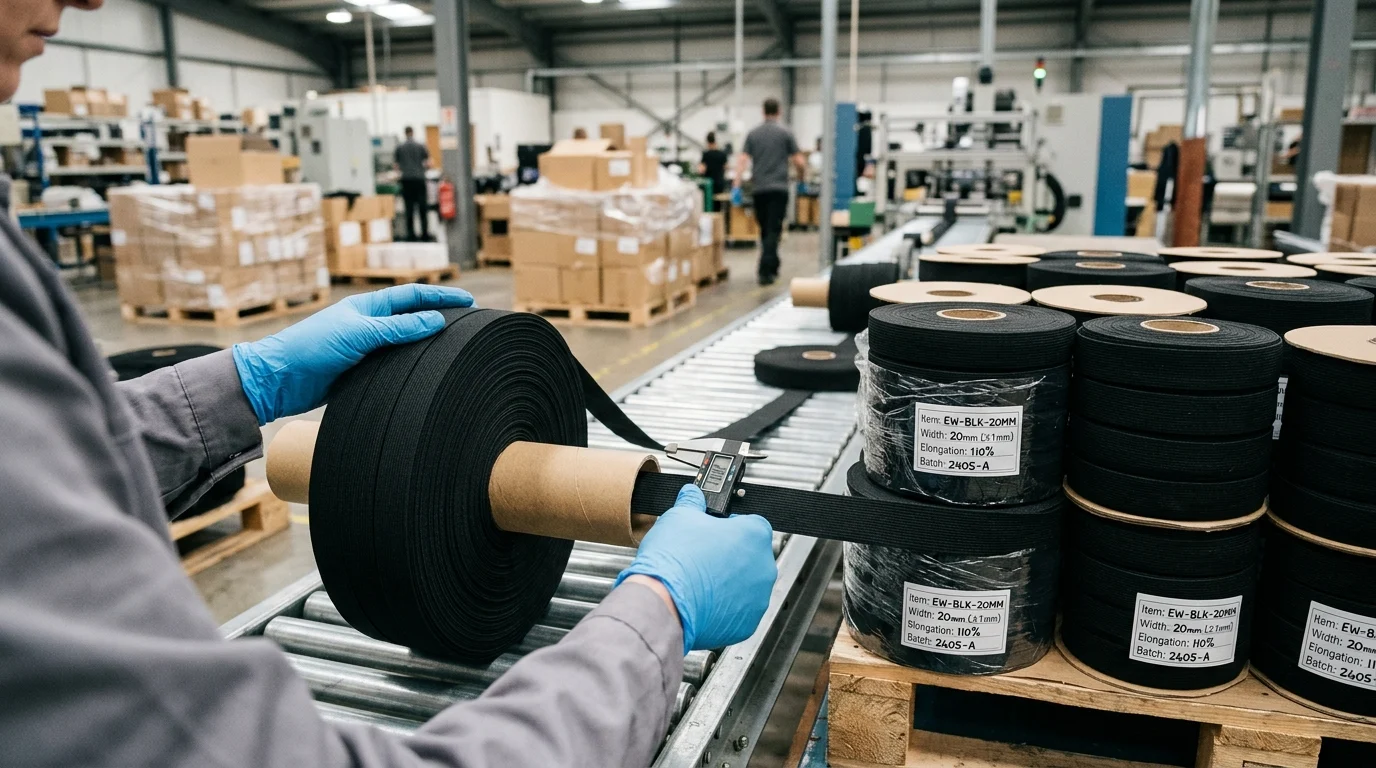
Specifying elastic webbing requires a granular approach to material science. Buyers and product developers must evaluate a matrix of physical properties, fiber blends, and finishing treatments to ensure the trim aligns with the garment’s intended end-use.
How to compare fiber composition, stretch, and recovery
The core performance of elastic webbing is dictated by its raw material composition. The rigid structural yarns are typically nylon or polyester, while the stretch is provided by elastane (spandex) or natural rubber cores. Nylon offers superior softness and higher abrasion resistance, making it ideal for skin-contact applications, whereas polyester provides exceptional UV resistance and colorfastness for outdoor apparel.
| Fiber Composition | Typical Stretch Range | Key Advantage | Optimal Sportswear Application |
|---|---|---|---|
| Nylon / Spandex | 130% – 150% | Soft hand-feel, high recovery | Sports bra underbands, premium leggings |
| Polyester / Spandex | 110% – 140% | UV resistance, cost-effective | Outerwear cuffs, swimwear |
| Polyester / Rubber | 100% – 120% | High tension, durable | Heavy-duty waistbands, footwear |
Which constructions, finishes, and performance tests matter
The construction method—woven, knitted, or braided—fundamentally alters the webbing’s behavior. Woven elastics are the gold standard for high-end sportswear because they do not narrow when stretched and offer a dense, durable structure. Knitted elastics are softer and more breathable but may lose width under tension, making them better suited for lightweight activewear.
Finishes and physical testing are equally critical. Silicone gripper applications are often added to the inner face of cycling or running apparel webbing to prevent riding up. Performance validation should include standardized testing, such as ASTM D4964 for tension and elongation, ensuring the webbing meets the specified force thresholds (e.g., requiring exactly 4.5 lbs of force to reach 40% elongation).
What buyer criteria to use when evaluating options
When evaluating webbing options, procurement teams must look beyond basic dimensions. Weight, measured in grams per square meter (GSM), and thickness are vital parameters. A standard waistband elastic typically measures between 1.2mm and 2.5mm in thickness; anything thicker may cause bulky, uncomfortable seams.
Cost per meter must be weighed against these physical specifications. Buyers should establish acceptable tolerance levels for width variations (standard industry tolerance is ±1mm for widths under 30mm) and ensure the supplier’s technical data sheets explicitly guarantee the required modulus and recovery metrics.
How to Match Elastic Webbing to Sportswear Product Design
Successfully integrating elastic webbing into a sportswear collection requires tight alignment between the design vision and manufacturing realities. A mismatch between fabric properties and webbing specifications can lead to puckered seams, restricted movement, or premature garment failure.
What process helps align webbing with product requirements
The alignment process begins during the prototyping phase. Designers must conduct tension-matching exercises to ensure the stretch of the elastic webbing complements the stretch of the primary garment fabric. If a high-compression woven elastic is paired with a lightweight, four-way stretch knit (e.g., a 150 GSM fabric), the webbing will overpower the fabric, causing aggressive gathering and seam distortion.
To mitigate this, product developers utilize stretch-to-fit ratios. For instance, a waistband elastic might be cut 10% to 15% shorter than the garment’s waist opening. By constructing physical mock-ups and performing dynamic wear testing, design teams can fine-tune this ratio, ensuring the webbing provides adequate hold without compromising the structural integrity of the surrounding textile.
How to balance performance, cost, and order quantities
Balancing high-end performance with commercial viability requires careful navigation of supplier constraints, particularly Minimum Order Quantities (MOQs). Custom-engineered webbing, such as jacquard elastics featuring woven brand logos, typically demands MOQs ranging from 3,000 to 5,000 meters per colorway due to the complex setup required on jacquard looms.
For smaller production runs or capsule collections, brands often opt for stock solid-color elastics, which may carry MOQs as low as 500 meters. To balance cost and performance, brands can utilize generic high-quality woven elastics for internal, hidden applications (like encased waistbands) while reserving capital-intensive, custom-branded jacquard webbing for highly visible structural accents.
What Quality, Compliance, and Supply Risks Buyers Should Assess
Procuring sportswear trims involves navigating a complex landscape of quality assurance and regulatory compliance. Failing to assess these risks can result in costly product recalls, delayed launches, and damage to brand reputation.
Which defects, testing checkpoints, and in-line controls matter
Rigorous in-line quality controls are essential to prevent structural defects. Common webbing defects include needle cutting (where the sewing needle severs the elastane core), broken yarns, and uneven tension during the weaving process. Buyers should enforce strict Acceptable Quality Limit (AQL) standards, typically requiring an AQL of 2.5 for minor defects and 1.5 for major defects.
Testing checkpoints must be established both at the supplier’s facility and upon receipt at the garment factory. Shrinkage testing is particularly critical; high-quality elastic webbing should exhibit less than 3% shrinkage after five standard wash-and-dry cycles to prevent the garment from puckering post-purchase.
How to assess chemical compliance, skin safety, and colorfastnes
s
Because elastic webbing often sits directly against the athlete’s skin, chemical compliance is non-negotiable. Buyers must ensure that all trims meet stringent safety standards, such as OEKO-TEX Standard 100, Class II (for direct skin contact), guaranteeing the absence of harmful substances like azo dyes, heavy metals, and formaldehyde.
Colorfastness is another major risk factor in sportswear, which is frequently exposed to sweat, friction, and frequent laundering. Webbing must be tested to ISO 105-C06 (colorfastness to washing) and ISO 105-E04 (colorfastness to perspiration), with buyers typically demanding a minimum performance grade of 4 on a 5-point scale to prevent dye migration onto adjacent lighter fabrics.
What logistics, lead time, sampling, and supplier factors to review
Supply chain logistics can severely impact production timelines if not carefully managed. Lead times for custom elastic webbing generally require 14 to 21 days for lab dip approvals and initial sampling, followed by 30 to 45 days for bulk production. Buyers must factor these timelines into their critical path management.
| Supply Chain Phase | Typical Lead Time | Key Buyer Action |
|---|---|---|
| Lab Dips / Color Matching | 14 – 21 Days | Review under D65 light source |
| Pilot Sampling | 10 – 15 Days | Conduct physical modulus testing |
| Bulk Production | 30 – 45 Days | Enforce AQL inspections prior to shipment |
Thoroughly reviewing a supplier’s historical on-time delivery rates and raw material sourcing transparency is crucial. Brands should establish direct communication protocols, utilizing channels like a supplier’s contact us portal to verify production capacities and request detailed compliance documentation before finalizing purchase orders.
How to Make Better Elastic Webbing Sourcing Decisions
Making informed sourcing decisions for elastic webbing requires transitioning from transactional purchasing to strategic supplier partnerships. A structured, data-driven approach to vendor selection ensures long-term consistency in garment performance.
Which supplier scorecard and decision criteria to use
Implementing a comprehensive supplier scorecard is the most effective way to evaluate potential partners. Key decision criteria should be weighted based on the brand’s specific needs. Critical metrics include the supplier’s historical defect rate (targeting strictly <2% across all deliveries), their ability to maintain consistent width and stretch modulus across different production batches, and their adherence to environmental compliance standards.
Furthermore, buyers should assess the technological capabilities of the manufacturer. Suppliers utilizing modern, computerized jacquard looms and automated tension-control systems consistently produce higher-quality webbing than those relying on legacy equipment. Understanding a vendor’s background and manufacturing philosophy, often detailed on their about us page, can provide valuable insight into their commitment to quality and innovation.
How to plan pilot runs, approvals, and scale-up
Once a supplier is selected, mitigating risk during the transition to bulk production requires a phased scale-up plan. Rather than moving directly from a 5-meter sample to a 50,000-meter bulk order, buyers should mandate a pilot run. A typical pilot run of 100 to 200 meters allows the garment factory to test the webbing on actual production sewing machines.
During this pilot phase, factory technicians evaluate the webbing’s behavior under high-speed sewing, checking for issues like needle heat damage or feeding inconsistencies. Only after the pilot garments pass all physical wash, stretch, and wear tests should the procurement team issue the final approval for full-scale bulk production, thereby safeguarding the entire manufacturing investment.
Further reading:
Key Takeaways
- The most important conclusions and rationale for sportswear accessories
- Specs, compliance, and risk checks worth validating before you commit
- Practical next steps and caveats readers can apply immediately
Frequently Asked Questions
What elastic webbing width works best for sportswear waistbands?
Use 25mm to 50mm elastic for yoga pants and running tights. Wider webbing improves anchoring, reduces rolling, and supports multi-directional movement better than narrow options.
Which fiber blend is best for skin-contact sportswear?
Nylon/spandex is usually best for skin-contact zones like sports bra underbands. It offers a softer hand-feel, strong recovery, and good abrasion resistance for better comfort.
Should I choose woven or knitted elastic webbing?
Choose woven elastic for premium, high-stress sportswear because it stays stable and does not narrow when stretched. Use knitted elastic for lighter activewear where softness and breathability matter more.
How can manufacturers test elastic webbing performance before production?
Check stretch, recovery, and force-to-elongation with standardized tests such as ASTM D4964. A practical target is about 95% recovery and a defined force requirement at a set elongation.
Where can I explore sportswear accessory options similar to this article’s recommendations?
You can review sportswear accessory products on tramigoblog.com/products/ to compare elastic webbing-related options and materials for activewear development.


