
Introduction
Material choice in webbing affects far more than cost: it determines load capacity, wear life, moisture behavior, and suitability for demanding environments. Nylon and polypropylene are both widely used, but they perform very differently under tension, abrasion, sunlight, and repeated exposure to water or chemicals. This comparison explains where each material is stronger, where it falls short, and how those differences influence durability in real applications such as tie-downs, outdoor gear, marine use, and industrial products. By the end, readers will have a clear basis for deciding which webbing better fits their performance requirements, service conditions, and replacement expectations.
Why Nylon vs Polypropylene Webbing Matters
Industrial webbing applications demand precise material specification, as the selected polymer dictates the structural integrity, safety, and lifecycle of the final product. Choosing between nylon and polypropylene is a foundational engineering decision that directly impacts performance under dynamic loads and extreme environmental conditions.
While both materials serve as critical components in cargo control, marine rigging, tactical gear, and medical devices, their molecular structures yield vastly different mechanical properties. Failing to match the correct polymer to the application’s specific stress factors can lead to catastrophic failure, regulatory non-compliance, and inflated replacement costs.
Procurement priorities and end-use risk
Procurement teams must align material specifications with end-use risk profiles, particularly concerning load-bearing requirements. A standard 1-inch flat nylon webbing typically boasts a breaking strength of up to 4,000 lbs (1,814 kg), making it suitable for life-safety and heavy-duty tie-down applications. In contrast, standard 1-inch polypropylene webbing generally maxes out between 900 and 1,200 lbs (408 to 544 kg).
This significant gap in tensile strength dictates risk assessment protocols. Utilizing polypropylene in high-stress environments introduces severe liability, whereas over-engineering a low-stress, disposable product with heavy-duty nylon results in unnecessary procurement waste. Engineers must calculate the Working Load Limit (WLL) and apply an appropriate safety factor—often 5:1 for general industrial use—before selecting the polymer.
Commercial impact of material choice
The commercial implications of this material choice extend beyond unit cost to encompass total cost of ownership (TCO) and supply chain logistics. Nylon is generally 30% to 50% more expensive than polypropylene per yard, a premium driven by its complex manufacturing process and superior mechanical properties.
For high-volume manufacturing requiring minimum order quantities (MOQs) of 10,000 yards or more, this price differential significantly alters production budgets. However, buyers must weigh upfront savings against lifecycle costs. In high-abrasion environments, nylon's extended operational lifespan often offsets its higher initial purchase price, reducing the frequency of warranty claims and product replacements.
Material and Performance Differences
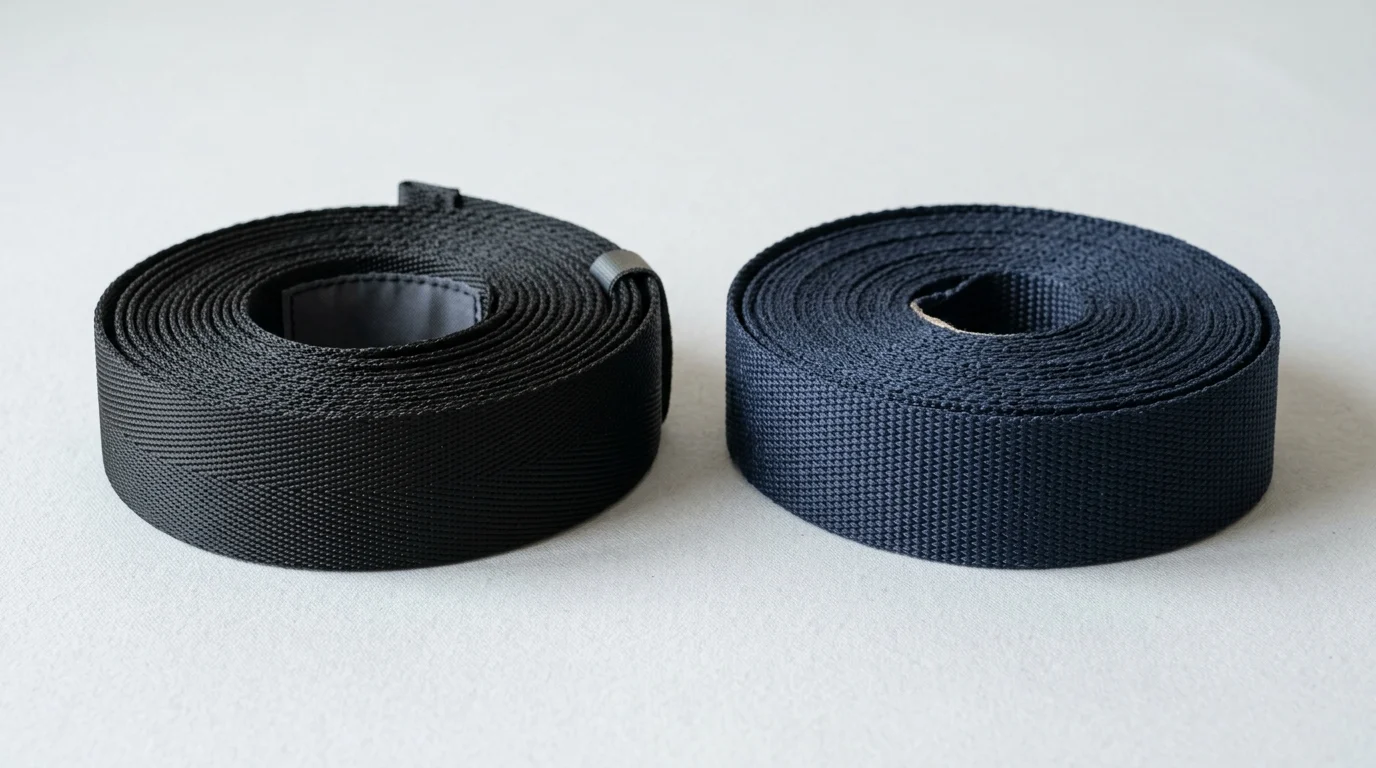
The macro-level performance of nylon and polypropylene webbing is entirely dependent on the fundamental polymer science governing each material. Understanding these differences allows engineers to accurately predict how the webbing will behave when subjected to friction, tension, and elemental exposure.
Strength, abrasion, and stretch
Nylon (polyamide) features exceptional abrasion resistance and a high strength-to-weight ratio. Under heavy loads, nylon exhibits a stretch coefficient of roughly 15% to 20%. This elongation provides critical shock absorption, dispersing kinetic energy during sudden impacts, which is vital for fall protection and towing applications.
Polypropylene, an addition polymer made from the monomer propylene, offers minimal stretch—typically under 10% at maximum load. While this lack of elasticity is beneficial for applications requiring rigid load stabilization, its lower abrasion resistance makes it highly susceptible to fraying and structural degradation when subjected to repetitive friction over rough edges.
Moisture, UV, mildew, and chemical resistance
Environmental exposure drastically alters the performance of industrial textiles. Polypropylene is hydrophobic, absorbing 0% of its weight in water. This renders it naturally buoyant, completely impervious to mildew, and highly resistant to most acids and alkalis, making it the industry standard for marine and chemical environments.
Conversely, nylon is hydrophilic and can absorb up to 9% of its weight in water. When saturated, nylon's tensile strength can decrease by 10% to 15%, and it becomes heavier and slower to dry. Regarding ultraviolet (UV) exposure, both materials require chemical UV inhibitors for prolonged outdoor use; however, untreated nylon degrades rapidly in direct sunlight, potentially losing up to 50% of its tensile strength after 12 months of continuous exposure.
Quick comparison table
The following matrix quantifies the baseline material differences to assist in rapid engineering assessments.
| Performance Metric | Nylon Webbing (Standard 1-Inch) | Polypropylene Webbing (Standard 1-Inch) |
|---|---|---|
| Average Tensile Strength | 3,000 – 4,000 lbs | 900 – 1,200 lbs |
| Elongation / Stretch | 15% – 20% (High shock absorption) | < 10% (Low shock absorption) |
| Water Absorption | Up to 9% (Sinks, loses strength wet) | 0% (Floats, retains strength wet) |
| Abrasion Resistance | Excellent | Fair to Poor |
| Chemical Resistance | Weak to acids, strong to alkalis | Excellent to most acids and alkalis |
How Buyers Should Evaluate Webbing
Purchasing managers and quality assurance engineers must look beyond baseline polymer characteristics to evaluate the finished textile. The manufacturing process, applied treatments, and adherence to testing standards directly influence the final webbing's viability for commercial and industrial deployment.
Construction, finish, and coatings
The construction of the webbing—specifically the weave pattern and yarn denier—plays a critical role in its durability. Tubular nylon webbing, woven as a flattened tube, offers superior edge-abrasion resistance compared to standard flat weaves, making it a staple in climbing and tactical gear.
Additionally, post-weave finishes and chemical coatings can alter a material's natural properties. Resin treatments can be applied to nylon to increase stiffness and reduce water absorption by up to 40%, mitigating one of its primary weaknesses. Polypropylene is frequently extruded with color pigments directly in the polymer melt, resulting in excellent colorfastness that will not bleed or fade as quickly as surface-dyed nylon.
Testing standards and quality control
Procurement specifications must mandate adherence to recognized testing standards to ensure consistent quality. For military and aerospace applications, nylon webbing is often manufactured to strict specifications such as MIL-W-4088, which dictates exact yarn types, weave structures, and breaking strengths (e.g., Type VIII nylon mandated at 4,000 lbs tensile strength).
Commercial polypropylene webbing typically follows standards like ASTM D6770 for tension testing of textile webbing. Quality control protocols should require suppliers to provide certificates of analysis (CoA) proving that lot defect rates remain below the industry standard threshold of 1.5%, ensuring reliability in high-volume production runs.
Cost, lifespan, and failure risk
Evaluating the true cost of webbing requires a lifecycle analysis. In bulk commercial quantities, standard polypropylene webbing generally ranges from $0.15 to $0.25 per yard, presenting an attractive upfront cost for high-volume consumer goods.
Standard nylon webbing averages $0.35 to $0.60 per yard. However, if polypropylene is deployed in an application with high friction or heavy dynamic loads, the failure risk increases exponentially. A 5% failure rate in the field due to premature abrasion can result in product recalls and liability claims that vastly exceed the $0.20 per yard savings realized during initial procurement.
Practical Selection Process
Establishing a robust and repeatable selection process requires engineers to map environmental variables against mechanical demands. Standardizing this workflow prevents specification errors and ensures procurement teams source the most cost-effective material that meets all safety parameters.
Step-by-step specification process
A rigorous specification process begins with calculating the required Working Load Limit (WLL) and applying an industry-appropriate safety ratio, commonly 5:1 for hardware and rigging, or 10:1 for life-safety equipment.
Next, engineers must audit the operational environment, assessing the likelihood of UV exposure, chemical contact, and moisture saturation. Finally, dimensional constraints must be established. Procurement documentation should specify width and thickness tolerances, typically demanding a thickness tolerance of ±0.015 inches to ensure compatibility with buckles, adjusters, and automated sewing machinery.
When nylon is the better choice
Nylon is the definitive choice for applications requiring extreme durability, high load capacities, and dynamic shock absorption. It is the industry standard for fall protection harnesses, heavy cargo tie-downs, towing straps, and tactical military equipment.
When the application demands a breaking strength exceeding 3,000 lbs and the webbing will be subjected to continuous friction against metal hardware or rough surfaces, nylon’s superior abrasion resistance justifies its higher procurement cost and weight.
When polypropylene is the better choice
Polypropylene excels in environments where moisture resistance, chemical inertness, and cost-efficiency are prioritized over absolute tensile strength. It is universally specified for marine applications, life jackets, and pool safety equipment due to its zero water absorption and natural buoyancy.
Furthermore, polypropylene is the optimal choice for lightweight consumer goods, such as backpack straps, medical bracing, and promotional lanyards, where the structural load rarely exceeds 100 lbs and minimizing material costs is a primary commercial objective.
Decision Framework and Conclusion
The final material specification relies on balancing mechanical safety margins against economic feasibility. Over-engineering with nylon in lightweight applications wastes budget, while under-engineering with polypropylene in load-bearing scenarios introduces unacceptable catastrophic failure risks. Standardizing the decision-making process ensures consistency across product lines.
Simple decision matrix
To streamline procurement decisions, engineering teams should utilize a standardized matrix that aligns the application domain with environmental threats and required safety factors.
| Application Domain | Primary Threat / Factor | Minimum Safety Factor | Recommended Material |
|---|---|---|---|
| Marine & Water Rescue | Water absorption, Rot | 3:1 to 5:1 | Polypropylene |
| Heavy Rigging & Towing | Shock load, Abrasion | 5:1 | Nylon |
| Medical & Orthopedic | Chemical sanitization, Cost | 2:1 | Polypropylene |
| Tactical & Fall Protection | Extreme tension, Friction | 10:1 | Nylon |
| Light Consumer Bags | Unit cost, Colorfastness | 2:1 | Polypropylene |
By strictly adhering to empirical data regarding tensile thresholds, stretch coefficients, and environmental degradation rates, manufacturers can confidently navigate the trade-offs between nylon and polypropylene. Ultimately, the durability of the webbing is not defined by the material in isolation, but by how accurately the polymer's inherent properties are matched to the specific demands of the operational environment.
Key Takeaways
- The most important conclusions and rationale for Nylon Webbing and Polypropylene
- Specs, compliance, and risk checks worth validating before you commit
- Practical next steps and caveats readers can apply immediately
Frequently Asked Questions
Which webbing is more durable for heavy-duty use?
Nylon is usually more durable under high loads and abrasion. A 1-inch nylon webbing can reach about 3,000–4,000 lbs breaking strength, making it better for tie-downs, towing, and safety gear.
When is polypropylene webbing the better choice?
Choose polypropylene for wet, marine, or chemical-exposed environments. It absorbs no water, floats, resists mildew, and handles many acids and alkalis better than nylon.
Does nylon webbing lose strength when wet?
Yes. Nylon can absorb up to 9% of its weight in water and may lose about 10%–15% of its tensile strength when saturated, so it is less ideal for constantly wet applications.
Is polypropylene webbing strong enough for load-bearing applications?
Usually only for lighter-duty jobs. Standard 1-inch polypropylene webbing is often around 900–1,200 lbs breaking strength, so always verify the required Working Load Limit before specifying it.
How do cost and lifespan compare between nylon and polypropylene?
Polypropylene is cheaper upfront, while nylon often lasts longer in abrasive service. For high-wear applications, nylon’s longer service life can reduce replacements and lower total cost over time.


