
Introduction
Choosing between PVC reflective tape and fabric reflective tape affects more than visibility. The material you specify influences durability, wash performance, flexibility, comfort, compliance, and overall production cost. This article explains how PVC reflective tape differs from fabric-based options in structure, reflective technology, and real-world use, with attention to industrial garments and demanding work environments. You will learn where PVC tape performs best, where fabric tape offers advantages, and which factors matter most when comparing safety requirements, garment design, and long-term value. With that foundation, the detailed comparison in the body will be easier to evaluate and apply.
Why PVC Reflective Tape vs Fabric Reflective Tape Matters
Selecting the optimal high-visibility material is a critical procurement decision that directly impacts occupational safety, garment lifecycle, and manufacturing overhead. The debate between PVC reflective tape and fabric reflective tape centers on balancing fundamental optical technologies—microprismatic versus glass bead—against the physical demands of the end-use environment. With global occupational safety regulations becoming increasingly stringent, specifying the correct retroreflective trim is no longer a localized compliance issue but a core component of global risk management.
For procurement professionals and industrial designers, understanding the structural and commercial divergence between these two materials is essential. While both materials achieve the primary goal of reflecting light back to its source, their distinct manufacturing processes result in vastly different physical properties. Making an informed choice requires a deep dive into environmental durability requirements, supply chain mechanics, and the specific compliance thresholds mandated by international safety standards.
How end-use requirements affect material choice
End-use environments dictate strict performance boundaries that immediately narrow material selection. High-visibility gear deployed in heavy marine, sanitation, or emergency response sectors frequently encounters extreme moisture and chemical exposure. In these scenarios, the non-porous nature of PVC reflective tape prevents water absorption and structural degradation, maintaining its retroreflective integrity even when submerged (often tested to withstand >10,000mm hydrostatic head pressure). Conversely, industrial workwear designed for construction or logistics requires high breathability, flexibility, and the ability to withstand rigorous industrial laundering. Here, fabric reflective tape integrates seamlessly with the host garment, flexing with the wearer and surviving high-temperature wash cycles without delaminating.
Furthermore, the physical rigidity of the host material plays a decisive role. Applying stiff PVC tape to lightweight, 120-150 GSM polyester safety vests often results in puckering, compromised wearer mobility, and premature failure at the seam. Applying the same PVC tape to heavy-duty 500D nylon rainwear or rigid traffic cones, however, leverages the material’s inherent structural stability. Buyers must map the exact physical stresses the final product will endure before drafting material specifications.
What procurement risks buyers should consider
Procurement teams face distinct supply chain dynamics when sourcing these materials. Minimum Order Quantities (MOQs) and lead times vary significantly based on the manufacturing complexity of the substrate. PVC reflective tape, which often requires custom tooling and high-frequency welding during production, typically demands MOQs ranging from 3,000 to 5,000 meters per color or pattern. Production lead times for custom PVC runs can extend to 25-35 days, exposing buyers to potential inventory bottlenecks if forecasting is inaccurate.
Fabric reflective tape, benefiting from continuous roll-to-roll coating processes, generally offers more flexible procurement terms. Standard silver glass-bead fabric tapes often feature MOQs as low as 500 to 1,000 meters, with lead times averaging 10 to 15 days for standard stock. However, buyers must account for the risk of batch-to-batch optical inconsistency. Poorly controlled glass bead distribution can result in retroreflectivity variances of up to 15% between rolls, necessitating stringent incoming Quality Control (QC) protocols to prevent non-compliant garments (which can carry rejection rates of 3-5% if unchecked) from reaching the market.
Material and Performance Differences Between PVC and Fabric Reflective T
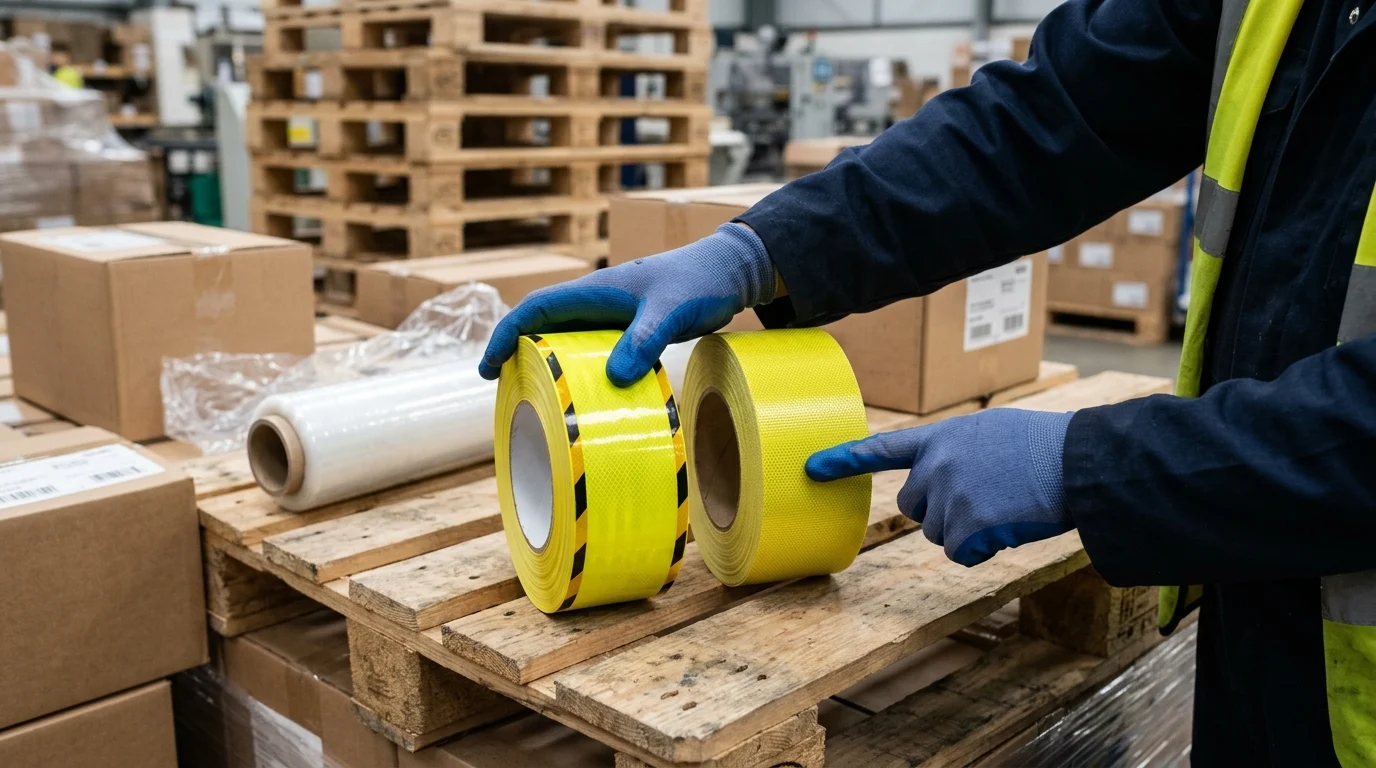
The technical performance of reflective tapes is fundamentally tied to their microscopic architecture. The industry relies on two primary mechanisms for returning light to its source: microprismatic arrays and spherical glass beads. Understanding how these technologies are embedded into their respective substrates explains their divergent performance metrics in flexibility, abrasion resistance, and photometric output.
How substrate and reflective construction differ
PVC reflective tape utilizes microprismatic technology. Microscopic, three-dimensional prisms are embossed into a polymeric film, which is then sealed with a durable UV-stabilized PVC top layer (typically 0.2mm to 0.4mm thick). This closed-cell construction traps air behind the prisms, allowing for internal reflection. Because the reflective elements are protected beneath a smooth polymer shield, the tape remains highly effective in wet conditions, as water simply runs off the surface without disrupting the optical path.
Fabric reflective tape relies on exposed lens technology. Millions of microscopic glass beads, typically engineered with a high refractive index (Nd > 1.9), are half-embedded into a flexible binder resin coated over a polyester or poly-cotton backing (ranging from 100 to 250 GSM, such as a standard 65/35 blend). When light strikes the exposed upper hemisphere of the glass beads, it refracts, reflects off the mirrored rear surface inside the resin, and returns to the source. Because the beads are exposed, the substrate remains incredibly pliable, mimicking the drape of standard textiles.
How durability, flexibility, and abrasion resistance compare
Durability profiles diverge significantly under physical stress. The smooth outer layer of PVC tape offers superior resistance to abrasion and chemical splashes. However, standard PVC formulations are susceptible to cold cracking; without specialized cold-resistant plasticizers, PVC tape can become brittle and fracture at temperatures below -20°C. Additionally, PVC cannot withstand the high heat of industrial laundering or tumble drying without melting or warping.
Fabric tape excels in flexibility and thermal stability. High-grade fabric tapes are engineered to endure 50 to 100 domestic wash cycles at 60°C, and specialized industrial wash variants can survive temperatures up to 85°C. The trade-off is abrasion resistance. Because the glass beads are physically exposed on the surface, repeated friction against rough surfaces can dislodge the beads or scratch their lenses, gradually degrading the tape’s coefficient of retroreflection over time.
Which key comparison points matter most for buyers
To facilitate accurate procurement decisions, buyers must weigh these structural and performance variables against their specific product requirements. The following table outlines the critical comparative metrics:
| Feature/Metric | PVC Reflective Tape | Fabric Reflective Tape |
|---|---|---|
| Optical Technology | Microprismatic | Glass Bead (Exposed Lens) |
| Typical Retroreflectivity | 400 – 700 cd/(lx·m²) | 330 – 500 cd/(lx·m²) |
| Washability | Poor (Wipe clean only) | Excellent (Up to 100 cycles at 60°C) |
| Wet Weather Performance | Excellent (100% output retained) | Moderate (Output drops when saturated) |
| Flexibility | Rigid / Semi-rigid | High (Mimics textile drape) |
| Cold Resistance | Prone to cracking below -20°C | Excellent flexibility below -30°C |
How Buyers Should Evaluate Compliance, Application, and Total Cost
Evaluating reflective tape extends beyond baseline material properties; it requires a comprehensive analysis of regulatory compliance, manufacturing integration, and total lifecycle costs. A tape that appears cost-effective on a per-meter basis can quickly become a financial liability if it fails third-party certification testing or introduces inefficiencies on the factory floor.
Which standards and testing data to review
Global safety directives, such as EN ISO 20471 (Europe) and ANSI/ISEA 107 (North America), establish strict photometric and physical requirements for high-visibility garments. For a tape to qualify for Class 2 or Class 3 workwear, it must achieve a minimum coefficient of retroreflection (R_A) of 330 cd/(lx·m²) at specific observation (e.g., 12′) and entrance angles (e.g., 5°). Buyers must demand certified test reports from accredited third-party laboratories (e.g., SATRA, SGS, or TUV) verifying that the tape maintains this minimum threshold not only when new, but after standardized abrasion, flexing, folding at cold temperatures, and temperature variation tests.
Furthermore, specialized applications require specialized compliance. Flame-retardant (FR) garments mandate fabric tapes with an aramid backing (e.g., Nomex) that comply with EN 469 or NFPA 2112, ensuring the tape does not melt, drip, or propagate flames. PVC tapes are inherently unsuitable for FR applications due to their polymer composition, which melts at elevated temperatures.
How sewing, heat transfer, and adhesive bonding affect use
Application methodologies directly influence production line efficiency and garment integrity. Fabric tapes are highly versatile, easily attached using standard industrial lockstitch or chainstitch sewing machines. For seamless designs, segmented heat-transfer fabric tapes can be applied using pneumatic heat presses, typically requiring a dwell time of 10 to 15 seconds at 150°C to 160°C with 3-4 kg/cm² of pressure. This rapid application accelerates throughput but requires strict temperature calibration to prevent adhesive failure.
PVC tapes present different application challenges. While they can be sewn, puncturing the closed-cell microprismatic structure with a needle can allow water to ingress, damaging the reflective prisms and compromising the tape’s waterproof integrity. To maintain peak performance, PVC tape is optimally applied via High-Frequency (HF) welding or dielectric sealing. This requires specialized HF welding machinery, which represents a significant capital expenditure for garment manufacturers and limits the pool of capable cut-and-sew partner facilities.
| Application Method | Compatible Material | Typical Temp / Energy | Pressure / Dwell Time | Production Throughput |
|---|---|---|---|---|
| Industrial Sewing | Fabric, PVC (with caution) | N/A (Mechanical) | 8-12 stitches per inch | High (Standard cut & sew) |
| Heat Transfer | Segmented Fabric | 150°C – 160°C | 3-4 kg/cm² for 10-15s | Medium (Requires cooling) |
| High-Frequency (HF) Welding | PVC | 27.12 MHz (Standard HF) | 4-6 kg/cm² for 3-5s | High (Automated sealing) |
What drives total landed cost and replacement cycles
Analyzing the total landed cost requires calculating both the initial material acquisition and the projected replacement cycle. Standard PVC reflective tape is generally highly cost-competitive, often pricing between $0.15 and $0.30 per linear meter, making it attractive for budget-conscious accessories or disposable rainwear. High-grade, wash-resistant fabric tapes command a premium, typically ranging from $0.40 to $0.80 per meter, with specialized FR variants exceeding $1.50 per meter.
However, total cost of ownership shifts when factoring in lifecycle. If a municipal utility fleet requires garments that last 18 months of daily wear and weekly industrial laundering, fabric tape offers superior ROI. A cheaper PVC tape applied to a frequently washed garment will delaminate or crack within weeks, triggering a 100% replacement cost of the entire garment. Conversely, for stationary traffic bollards or heavy marine tarpaulins where washing is irrelevant but UV and rain exposure is constant, PVC’s extended environmental lifespan delivers the lowest total cost.
Best Sourcing and Quality Control Process for Reflective Tape
Establishing a robust quality assurance framework is vital to mitigating the risks of material failure and regulatory non-compliance. Sourcing reflective tape from unverified suppliers can lead to catastrophic batch rejections, customs seizures, or product liability claims. A systematic approach to supplier qualification and ongoing quality control is non-negotiable.
How to screen and qualify suppliers
Supplier qualification requires rigorous auditing of both manufacturing capabilities and quality management systems. Buyers should prioritize suppliers holding active ISO 9001:2015 certifications and request evidence of in-house photometric testing equipment, such as a calibrated retroreflectometer. It is critical to assess the supplier’s production capacity; a reliable manufacturer should demonstrate a stable output—often exceeding 1 million meters per month—to ensure they can absorb surge orders (e.g., 20%+ volume spikes) without subcontracting to unvetted tier-two facilities.
During the screening phase, procurement teams must verify the chemical compliance of the raw materials. Tapes must be certified free of restricted substances, complying with REACH (EU) and OEKO-TEX Standard 100 regulations. For PVC tapes, buyers must explicitly specify phthalate-free or low-toxicity plasticizers to meet modern environmental and occupational health directives (often targeting <0.1% by weight for restricted phthalates).
Which sample approvals and inspection checkpoints to use
Standardized inspection checkpoints must be implemented before any material enters the cut-and-sew line. Incoming QC should operate on a standard Acceptable Quality Limit (AQL), typically utilizing AQL 1.5 for major defects (e.g., dead spots, delamination) and AQL 4.0 for minor defects (e.g., slight color variance on the backing). Inspectors must pull samples from the beginning, middle, and end of a 50-meter roll to verify that the coefficient of retroreflection remains consistent across the entire web.
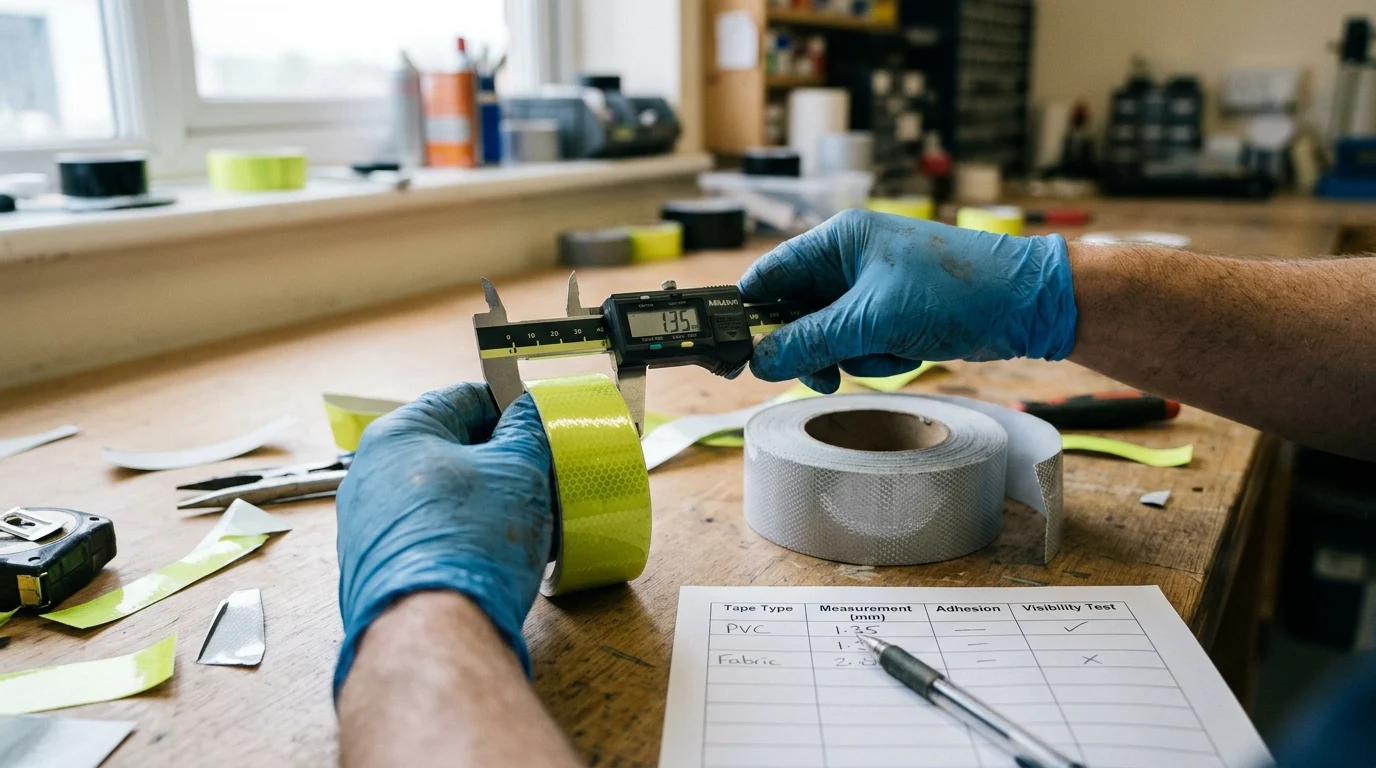
Pre-production sample approvals must include destructive testing aligned with the final product’s lifecycle.
PVC vs Fabric Reflective Tape: Which Is the Better Choice
Key Takeaways
- The most important conclusions and rationale for PVC Reflective Tape
- Specs, compliance, and risk checks worth validating before you commit
- Practical next steps and caveats readers can apply immediately
Frequently Asked Questions
When should I choose PVC reflective tape over fabric reflective tape?
Choose PVC tape for rainwear, marine gear, traffic cones, or wet/chemical environments. Its non-porous surface resists water and keeps reflectivity stable in harsh outdoor use.
When is fabric reflective tape the better option?
Use fabric tape for safety vests, construction wear, and uniforms needing softness, flexibility, and breathability. It usually performs better on lightweight garments and frequent industrial washing.
What sourcing risks should buyers consider for PVC reflective tape?
PVC tape often has higher MOQs, around 3,000–5,000 meters, and longer custom lead times of about 25–35 days. Plan forecasts early to avoid stock pressure and shipment delays.
How can buyers reduce quality risk when sourcing reflective tape from China?
Request samples, confirm test standards, and inspect reflectivity consistency before bulk production. A sourcing partner like Tramigo can help with supplier audits, production supervision, QC, and shipping coordination.
Can Tramigo help source customized reflective tape and related garment accessories?
Yes. Tramigo supports custom reflective tape sourcing plus zippers, webbing, buckles, hook and loop tape, and safety vests, with factory verification, sample collection, QC, and export support.


