

Introduction
Choosing between reflective tape and reflective fabric affects far more than appearance. In safety apparel, outdoor products, and industrial uniforms, the material choice shapes visibility performance, attachment method, wash durability, comfort, and compliance with standards such as ANSI/ISEA 107 or EN ISO 20471. This article explains how the two materials differ in construction, application, and long-term reliability, with a practical focus on commercial production and end-use risk. By the end, you will be able to compare where each option performs best, what trade-offs matter most in procurement, and how the right specification can reduce rework, compliance issues, and product failure in the field.
Why reflective tape vs reflective fabric matters in commercial use
Selecting the appropriate retroreflective material is a critical engineering and procurement decision in the manufacturing of high-visibility safety apparel (HVSA), outdoor gear, and industrial workwear. The distinction between reflective tape and reflective fabric directly impacts garment durability, manufacturing workflows, and ultimately, user safety in low-light environments.
While both materials serve the fundamental purpose of returning light to its source, their structural compositions and application methods dictate their suitability for specific operational environments. Understanding these differences allows production managers to optimize supply chains and ensures that finished products meet stringent international safety standards.
Procurement, compliance, and end-use risk
Procurement engineers and compliance officers must navigate rigorous regulatory landscapes when sourcing high-visibility materials. Standards such as ANSI/ISEA 107 in North America and EN ISO 20471 in Europe mandate strict performance baselines. For instance, Level 2 retroreflective materials must typically achieve a minimum initial coefficient of retroreflection (Ra) of 330 cd/lx/m².
Failing to specify the correct material type—whether a heat-applied tape or a sew-on fabric—can result in non-compliance if the material degrades prematurely under specific environmental stressors or laundering conditions. Procurement teams must therefore assess the end-use risk profile, matching the material’s structural resilience to the expected occupational hazards of the end user.
Failure costs, rework, and brand liability
Selecting an incompatible reflective medium leads to accelerated degradation, which translates directly into high failure costs and brand liability. If a heat-transfer reflective tape is applied to a heavily textured or highly stretchable substrate without proper adhesive formulation, it risks delamination well before the industry-standard threshold of 50 industrial wash cycles.
Conversely, utilizing a sew-on reflective fabric on waterproof or hermetically sealed garments requires seam sealing, introducing additional manufacturing steps and potential points of failure for water ingress. High rework rates on the factory floor and premature field failures not only erode profit margins but also expose manufacturers to liability claims if safety garments fail to maintain visibility requirements during their intended service life.
What reflective tape and reflective fabric are
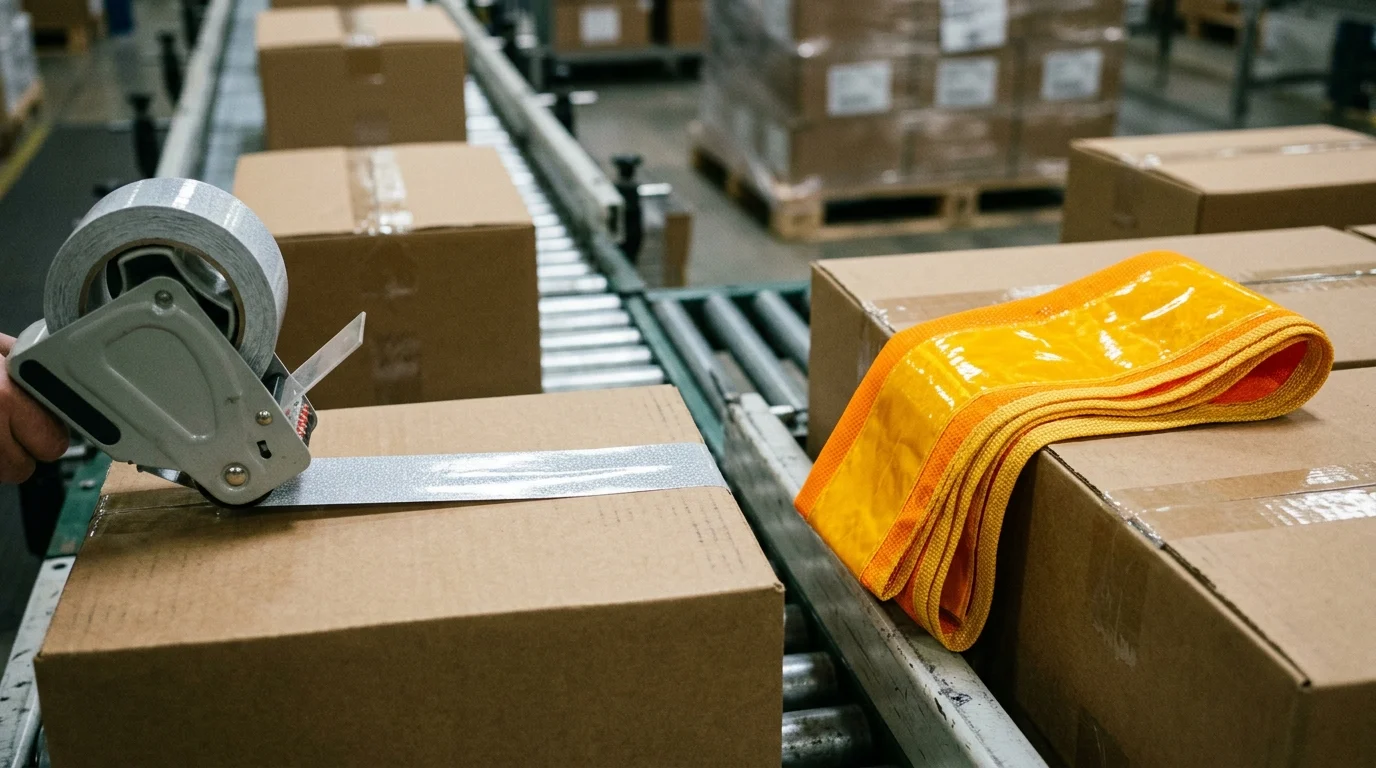
While often used interchangeably in casual industry parlance, reflective tape and reflective fabric represent fundamentally distinct material architectures. The core variance lies in the carrier substrate and the method by which the retroreflective elements are bonded to the garment.
Base materials, retroreflective technology, and adhesives
The retroreflective technology in both categories typically relies on either exposed glass beads with a high refractive index (Nd > 1.9) or microprismatic vinyl arrays. In reflective fabric, these glass beads are bonded to a durable textile backing—commonly 100% polyester, a polyester-cotton blend, or aramid fibers for flame resistance. This creates a pliable, sewable material.
Reflective tape, particularly heat-transfer tape, omits the textile backing. Instead, the reflective elements are temporarily held by a polyethylene terephthalate (PET) liner and backed with a thermoplastic hot-melt adhesive. The adhesive layer, usually ranging from 0.1mm to 0.2mm in thickness, is engineered to activate under specific heat and pressure conditions, bonding the reflective elements directly into the fibers of the target garment.
Common product variants and use cases
Industrial applications demand specific material variants tailored to distinct environmental stressors. Reflective fabric variants include lightweight perforated fabrics for highly breathable athletic wear, and heavyweight aramid-backed fabrics designed for firefighting turnout gear that must withstand extreme thermal exposures.
Reflective tapes are frequently utilized in seamless sportswear, waterproof rain gear, and rigid personal protective equipment (PPE). Segmented heat-transfer tapes, which feature engineered cuts or patterns, are increasingly common. These segmented variants allow the garment to stretch and breathe more effectively than solid continuous bands of reflective material.
| Feature | Reflective Fabric | Reflective Tape (Heat Transfer) |
|---|---|---|
| Base Substrate | Woven or knit textile (Polyester, Cotton, Aramid) | Thermoplastic adhesive film with PET liner |
| Application Method | Sewing / Stitching | Heat press / Thermal bonding |
| Flexibility | High (moves naturally with the garment) | Moderate to High (segmented designs improve stretch) |
| Weight | Heavier (due to textile backing) | Lighter (integrates seamlessly into target fabric) |
Performance differences between reflective tape and reflective fabric
Performance disparities between these materials manifest most prominently during application, laundering, and prolonged mechanical stress. Evaluating these metrics ensures the selected material aligns with the garment’s operational lifecycle.
Key specifications buyers should compare
Buyers must evaluate several critical specifications beyond initial brightness. Wash durability, tested under ISO 6330 (domestic washing) or ISO 15797 (industrial laundering), dictates how many cycles the material can endure before its Ra value drops below the compliance threshold of 100 cd/lx/m².
Other key specifications include dry cleaning compatibility (ISO 3175), abrasion resistance, and flame resistance (EN 469). Buyers must also evaluate the physical limitations of the application process itself, such as the required bonding temperature, dwell time, and pressure for heat-transfer tapes, compared to the needle size, thread tension, and stitch density required for sew-on fabrics.
| Performance Metric | Reflective Fabric (Sew-on) | Reflective Tape (Heat Transfer) |
|---|---|---|
| Industrial Wash Durability | Excellent (often exceeds 50-100 cycles) | Good to Excellent (highly dependent on adhesive match) |
| Application Constraints | Requires skilled sewing labor, risks puncturing waterproof membranes | Requires precise calibration of heat (130°C–150°C), time, and pressure |
| Breathability | Moderate (can be bulky over large areas) | High (especially if segmented) |
| Waterproof Integrity | Compromises waterproof membranes without seam sealing | Maintains waterproof integrity (no needle holes) |
When reflective tape performs better
Heat-transfer reflective tape excels when applied to rigid, waterproof, or synthetic substrates where stitching is impractical or detrimental. Because the application process bonds the adhesive directly to the garment at temperatures typically between 130°C and 150°C under 3 to 4 kg of pressure, it creates a seamless, low-profile integration.
Tape is the superior choice for high-performance athletic wear, softshell jackets, and rainwear. Segmented tapes perform exceptionally well on multi-directional stretch fabrics (like spandex blends), as the segmented gaps prevent the reflective material from restricting the garment’s elasticity or cracking under tension.
When reflective fabric performs better
Sew-on reflective fabric is the optimal choice for heavy-duty workwear, high-abrasion environments, and garments subjected to aggressive industrial laundering. The physical mechanical bond created by industrial stitching offers unparalleled reliability against delamination, particularly on heavily textured fabrics like canvas, denim, or insulated winter gear.
Furthermore, reflective fabric performs better in environments with extreme temperature fluctuations where hot-melt adhesives might become brittle in freezing conditions or soften under extreme radiant heat. For highly flexible, loose-fitting garments where drape and movement are prioritized, a lightweight sew-on fabric often yields a superior ergonomic result.
Sourcing, compliance, and total cost factors
Supply chain dynamics and total cost of ownership (TCO) extend far beyond the initial per-meter material price. Manufacturers must account for compliance verification, minimum order quantities, and production efficiency to maintain profitable operations.
Certifications, test methods, and regional standards
Global manufacturers must align material specifications with regional mandates. Beyond EN ISO 20471 and ANSI/ISEA 107, materials may need to comply with OEKO-TEX Standard 100 for harmful substances, or specific regional fire-retardant standards like NFPA 2112 in the United States. Verifying these certifications through accredited third-party testing laboratories is non-negotiable.
Procurement teams should source materials from suppliers who provide comprehensive testing documentation and batch-level traceability. Exploring a diverse range of certified products ensures that the selected material meets both the optical and chemical safety requirements of the target market.
MOQ, lead time, and supply chain variables
Supply chain variables heavily influence material selection. Standard sew-on reflective fabrics are often held in large stock quantities by suppliers, allowing for lower Minimum Order Quantities (MOQs)—frequently starting around 500 meters. This makes fabric highly accessible for smaller production runs or agile manufacturing models.
Conversely, custom heat-transfer tapes, particularly those with proprietary segmented designs or specialized adhesive formulations tailored to specific garment substrates, may require MOQs ranging from 3,000 to 5,000 meters. Lead times for custom tapes can also extend to 20–35 days, requiring more robust demand forecasting and inventory management.
How to calculate total cost of ownership
Calculating the Total Cost of Ownership (TCO) requires a holistic view of the manufacturing process. While the direct material cost per meter might be comparable, the application costs differ drastically. Sew-on fabric requires skilled sewing operators, thread consumption, and potentially slower throughput times. Heat-transfer tape enables rapid, automated application via heat presses, significantly reducing direct labor costs.
However, TCO calculations must also incorporate equipment depreciation (heat presses vs. sewing machines) and defect rates. Improperly calibrated heat presses can lead to high scrap rates; world-class manufacturing facilities target a scrap rate of less than 2%. Factoring in these variables provides a true picture of the financial impact of choosing tape versus fabric.
How manufacturers should choose between reflective tape and reflective f
Establishing a standardized procurement framework ensures that manufacturers optimize both safety compliance and production efficiency. The choice between tape and fabric should not be arbitrary, but rather the result of a systematic engineering evaluation.
A step-by-step evaluation process
Engineers should initiate the evaluation process by analyzing the base garment substrate. If the garment features a waterproof membrane, high elasticity, or a lightweight synthetic composition, heat-transfer tape is generally preferred. If the garment is constructed from heavy woven cotton, canvas, or requires industrial laundering, sew-on fabric is the safer choice.
Next, evaluate the target wash lifecycle. Determine whether the garment must survive 25, 50, or 100 wash cycles, and whether those cycles are domestic or industrial. Finally, conduct in-house compatibility testing. For heat-transfer tape, this involves testing multiple adhesive formulations to find the optimal bond strength for the specific garment material. Consulting with experts who understand these nuances—often detailed by established suppliers who share their methodology about us—can streamline this qualification phase.
Final decision criteria
The final decision ultimately hinges on balancing garment lifecycle expectations, which typically range from 1 to 5 years in industrial settings, with the manufacturer’s internal production capabilities. A facility optimized for high-volume automated heat pressing will naturally lean toward tape, while a traditional cut-and-sew operation may find fabric more cost-effective.
By rigorously comparing structural limitations, compliance data, and total application costs, brands can specify the ideal retroreflective solution. For project-specific guidance or to request material samples for compatibility testing, procurement teams are encouraged to contact us to discuss their unique manufacturing requirements.
Further reading:
Key Takeaways
- The most important conclusions and rationale for reflective tape vs reflective fabric
- Specs, compliance, and risk checks worth validating before you commit
- Practical next steps and caveats readers can apply immediately
Frequently Asked Questions
What is the main difference between reflective tape and reflective fabric?
Reflective fabric has a textile backing and is sewn on; reflective tape is usually heat-applied with adhesive. This affects weight, flexibility, waterproofing, and production speed.
Which option is better for waterproof rainwear?
Heat-transfer reflective tape is usually better because it avoids needle holes that can compromise waterproof seams. Verify adhesive compatibility with the shell fabric before bulk production.
When should manufacturers choose reflective fabric instead of tape?
Choose reflective fabric for garments needing stitching, high drape, or specialized backings like aramid for flame-resistant workwear. It is practical when seam construction already fits the product design.
How does the choice affect compliance with ANSI/ISEA 107 or EN ISO 20471?
Use a material that keeps required retroreflection after the garment’s expected wash and wear conditions. Matching the material to end use helps avoid premature failure and non-compliance.
What causes reflective tape to fail early on garments?
Common causes include wrong heat-press settings, poor adhesive match, textured or highly stretchable fabrics, and harsh laundering. Run wash and adhesion tests before approving production.


