

Introduction
Choosing reflective material for road construction vests affects how early drivers can detect workers, how clearly the human form stands out in cluttered work zones, and whether garments continue to perform after weather, dirt, and repeated wear. The right option is not simply the brightest-looking striping, but a material that delivers strong retroreflection, durability, and compliance with recognized safety standards. This article explains how reflective materials work, which performance measures matter most, and what trade-offs to expect between glass bead and microprismatic designs, so you can make a more informed selection for safer roadwork apparel.
Why Reflective Material Matters for Road Construction Vests
The efficacy of road construction safety apparel hinges primarily on its retroreflective capabilities. High-visibility safety apparel (HVSA) must actively return light to its source, ensuring that workers remain distinctly visible against complex, visually cluttered backgrounds. For procurement specialists and safety engineers, selecting the correct reflective material for road construction vests is not merely a matter of aesthetic preference, but a critical life-safety parameter governed by strict photometric performance criteria.
How reflective material affects worker visibility
Retroreflective materials operate by utilizing microscopic structures to bounce vehicle headlight beams directly back toward the driver’s optical axis. In professional-grade safety garments, this performance is quantified by the coefficient of retroreflection, denoted as R_A. A standard high-quality material engineered for road construction typically offers an initial R_A exceeding 330 cd/lx/m².
By maintaining or exceeding this photometric threshold, the material ensures workers remain conspicuous at distances that allow for safe driver reaction times. Proper retroreflection clearly delineates the human form through biomotion, especially when the material is applied to articulated joints like shoulders and waists, allowing motorists to immediately recognize a pedestrian presence.
What risks increase when visibility is poor
When retroreflectivity degrades or substandard materials are deployed, the physical risks to road crews escalate exponentially. The physics of vehicular momentum dictate strict visibility requirements; at highway speeds of 60 mph (96 km/h), a passenger vehicle requires approximately 300 feet (91 meters) to come to a complete stop under optimal conditions. Heavier commercial vehicles require significantly more braking distance.
If a vest’s reflective material exhibits an R_A that drops below the critical functional threshold of 100 cd/lx/m² due to poor initial quality or rapid degradation, a driver’s detection distance is severely truncated. This delayed recognition dramatically increases the probability of work-zone incursions, translating directly to higher rates of occupational fatalities and catastrophic injuries.
How to Compare Reflective Materials

Evaluating reflective material requires a thorough understanding of the underlying optical technologies and how they interact with garment substrates. Buyers must balance peak photometric performance against physical garment constraints such as flexibility, breathability, and required maintenance protocols.
Glass bead vs microprismatic vs segmented materials
The three primary technologies dominating the HVSA market are exposed glass bead, microprismatic, and segmented heat-transfer materials. Glass bead technology relies on millions of microscopic, high-index glass spheres embedded in a binder; it provides excellent flexibility and a wide observation angle. Microprismatic materials utilize geometric vinyl prisms sealed beneath a clear polymer film, yielding intensely focused light return that cuts through heavy rain. Segmented materials utilize cut patterns of glass bead film applied via heat press, maximizing garment stretch and airflow.
| Technology | Typical Initial R_A (cd/lx/m²) | Flexibility | Best Application |
|---|---|---|---|
| Glass Bead (Sew-on) | 330 – 500 | High | General roadwork, standard garments |
| Microprismatic | 500 – 700+ | Low to Medium | High-speed highway, heavy rain zones |
| Segmented Heat Transfer | 330 – 450 | Very High | Breathable mesh vests, active workers |
Key performance metrics buyers should review
Procurement professionals must scrutinize specific performance metrics beyond the initial R_A value. Wash durability is paramount; high-quality road construction vests should retain an R_A of at least 100 cd/lx/m² after 50 to 100 standard domestic wash cycles at 60°C (140°F). For industrial laundering, the material must withstand harsher chemicals and higher temperatures without delaminating.
Additionally, wet-weather performance metrics are critical. Buyers should review continuous-wet retroreflectivity test data, ensuring the material does not suffer a catastrophic drop in performance when submerged or subjected to simulated heavy rainfall.
How fabric compatibility and placement affect results
The interaction between the reflective tape and the base vest fabric dictates the garment’s overall lifespan. Heavy sew-on microprismatic tapes require robust base fabrics (typically exceeding 150 gsm) to prevent puckering and structural sagging over time. Conversely, applying rigid tapes to lightweight, highly elastic mesh can lead to premature mechanical failure at the stitch line.
Segmented heat-transfer films are highly compatible with lighter 120 gsm cooling meshes, as the gaps in the reflective segments allow the fabric to stretch naturally. However, the heat press application parameters (temperature, pressure, and dwell time) must be perfectly calibrated to the fabric’s synthetic blend to prevent adhesive failure in the field.
Standards and Service Conditions That Influence Performance
Reflective materials do not operate in a vacuum; their real-world efficacy is strictly bound by international regulatory frameworks and the severe environmental realities of active work zones. Understanding these dual pressures is vital for specifying compliant, long-lasting apparel.
ANSI, EN ISO, and project-specific requirements
In North America, ANSI/ISEA 107-2020 dictates the minimum performance and design requirements for HVSA. For road construction workers exposed to right-of-way traffic, Type R (Roadway) garments are mandatory. A Class 2 vest requires a minimum of 201 square inches of reflective material, while a Class 3 garment demands 310 square inches to accommodate higher speed environments. The standards require the reflective material to be at least 2 inches (50 mm) wide.
Similarly, the European EN ISO 20471 standard classifies garments based on the surface area of visible materials, demanding a minimum of 0.13 square meters of retroreflective tape for Class 2. Project-specific requirements often layer additional mandates over these baselines, such as requiring flame-resistant (FR) reflective tape compliant with ASTM F1506 for crews working near electrical hazards or volatile materials.
How weather, abrasion, and laundering affect durability
The service environment of road construction introduces relentless physical stressors. Prolonged exposure to ultraviolet (UV) radiation can degrade the polymer binders in glass bead tapes or yellow the top films of microprismatic materials, reducing light transmission. Abrasion from carrying heavy equipment, such as traffic cones or concrete forms, physically strips the glass beads from their substrate, causing localized dead spots in visibility.
Laundering represents another severe vector for degradation. Alkaline detergents, high-heat drying, and mechanical agitation accelerate the breakdown of reflective coatings. To counter this, heavy-duty road vests must utilize tapes specifically certified to ISO 6330 (domestic wash) or ISO 15797 (industrial wash), ensuring the R_A remains compliant throughout the garment’s designated lifecycle.
How to Evaluate Reflective Material Suppliers
Sourcing high-performance reflective material requires vetting suppliers through a rigorous industrial lens. The reliability of a safety garment manufacturer is directly tethered to the consistency and quality of their raw material partners.
Certification, quality control, and sourcing criteria
A credible supplier of reflective material must provide comprehensive, independent third-party testing reports from recognized laboratories such as SATRA, UL, or TUV. These reports must validate compliance with ANSI/ISEA 107 or EN ISO 20471. Furthermore, buyers should mandate ISO 9001 certification for the supplier’s manufacturing facilities to ensure batch-to-batch consistency.
Quality control thresholds should be explicitly defined in supply contracts. Acceptable defect rates for reflective rolls should be strictly capped below 1.0%. Additionally, ecological certifications like Oeko-Tex Standard 100 are increasingly critical to verify that the materials are free from harmful substances that could cause dermal reactions for workers.
| Evaluation Criterion | Minimum Acceptable Standard | Procurement Impact |
|---|---|---|
| Third-Party Certification | ANSI/ISEA 107-2020 / EN ISO 20471 | Ensures regulatory compliance and limits liability |
| Typical Defect Rate | < 1.0% | Reduces scrap rate in garment manufacturing |
| Minimum Order Quantity (MOQ) | 1,000 – 3,000 linear meters | Dictates inventory holding costs and capital lock-up |
| Slitting Tolerance | ± 1 mm | Critical for automated sewing and heat-press alignment |
Lead times, minimum order quantities, and customization
Logistical capabilities are just as critical as photometric performance. Standard lead times for bulk reflective material typically range from 3 to 6 weeks, but seasonal demands in construction can stretch these windows. Buyers must negotiate reliable delivery schedules to avoid stalling garment production lines.
Minimum Order Quantities (MOQs) usually hover between 1,000 and 3,000 linear meters for standard 50 mm silver tape. However, customization—such as bespoke widths, specialized FR backings, or custom-printed brand logos beneath the reflective surface—can drive MOQs to 5,000 meters or more. Suppliers must demonstrate precision in their slitting operations, maintaining tight tolerances (e.g., ± 1 mm) to ensure seamless integration with automated garment sewing machinery.
How to Choose the Best Material for Your Use Case
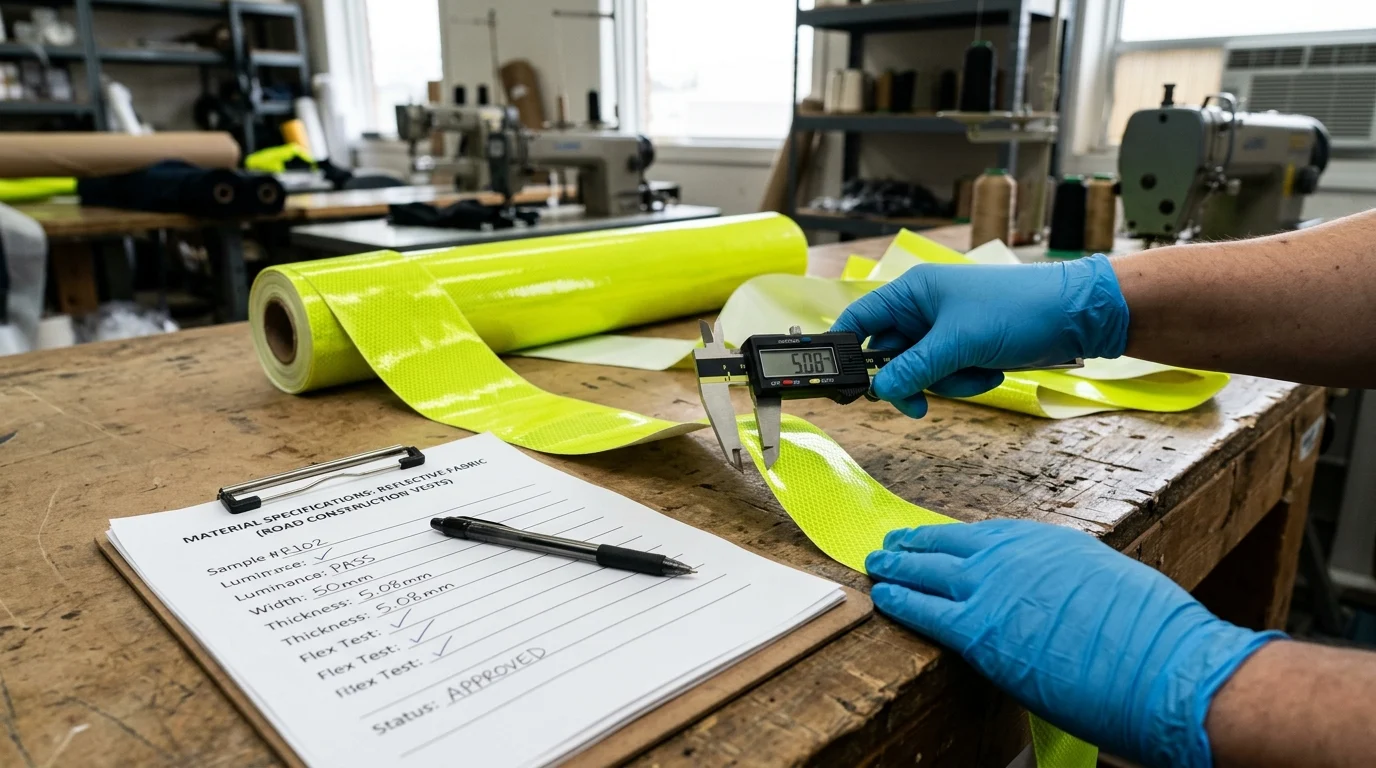
Selecting the optimal reflective material requires synthesizing environmental realities, safety compliance mandates, and budgetary constraints into an actionable procurement strategy. A systematic approach prevents over-engineering basic garments while ensuring high-risk roles receive adequate protection.
Steps to match material to job conditions
The first step is conducting a localized hazard assessment. If the job site involves highway-speed traffic exceeding 50 mph, microprismatic tape is often required due to its superior long-range visibility and wet-weather performance. Conversely, for urban roadwork in 25 mph zones where heavy physical labor is dominant, highly flexible, segmented glass-bead materials offer better comfort and heat dissipation.
Next, determine the maintenance lifecycle. Garments destined for heavy civil engineering projects that utilize industrial laundering programs must be equipped with industrial-wash rated tapes, which typically feature reinforced polyester backings. Attempting to use standard domestic-wash tape in these environments will result in catastrophic photometric failure within weeks, leading to severe compliance violations.
How to build a simple decision matrix
To objectify the selection process, procurement teams should construct a weighted decision matrix. Key variables typically include Initial R_A (weighted at 20%), Wash Durability (30%), Cost per Linear Meter (15%), Breathability/Flexibility (20%), and Wet Performance (15%).
By scoring suppliers against these metrics, buyers can accurately map materials to specific cost bands. Standard glass bead tapes usually occupy the $0.50 to $0.80 per linear meter range, while high-durability microprismatic or FR-rated segmented materials can scale from $1.50 to upwards of $2.50 per meter. Aligning the matrix score with the operational budget ensures that safety is maximized without incurring unnecessary premium costs for features not required by the specific job conditions.
Key Takeaways
- The most important conclusions and rationale for Material for Road
- Specs, compliance, and risk checks worth validating before you commit
- Practical next steps and caveats readers can apply immediately
Frequently Asked Questions
What reflective material is best for road construction vests?
It depends on the job: microprismatic suits highways and heavy rain, glass bead works for general roadwork, and segmented heat-transfer is best for breathable mesh vests.
What retroreflectivity level should buyers look for?
Choose material with an initial R_A above 330 cd/lx/m² and verify it stays above 100 cd/lx/m² after required washing or wear testing.
How does fabric type affect reflective tape selection?
Match the tape to the vest fabric. Rigid sew-on tapes need stronger fabrics, while segmented heat-transfer performs better on lightweight, stretchy mesh.
How important is wash durability for road safety vests?
Very important. Good vest material should keep functional reflectivity after 50 to 100 washes at 60°C without peeling, cracking, or sharp performance loss.
Can Tramigo help source custom reflective materials from China?
Yes. Tramigo supports factory verification, sample collection, customization, QC inspection, and shipping coordination for reflective tape and safety vest sourcing.


