
Introduction
In heavy-duty bags, zipper durability often determines whether the product survives years of hard use or fails long before the fabric does. The longest-lasting option depends on more than material alone: tooth design, chain size, slider quality, load direction, and operating conditions all affect service life under stress. This article compares the main zipper types used in industrial, tactical, and commercial bags, explains where each performs best, and highlights the tradeoffs between strength, abrasion resistance, repairability, and cost. By the end, you’ll have a practical basis for choosing a heavy duty zipper that matches the bag’s real workload and reduces premature failure.
Why Heavy-Duty Zipper Selection Matters
The structural integrity of industrial, tactical, and commercial bags relies heavily on their closure systems. In high-stress applications, a specialized heavy duty zipper is not merely an accessory; it is a primary load-bearing component that dictates the overall reliability of the product.
When specifying hardware for gear designed to carry heavy tools, expedition equipment, or military payloads, the margin for error is virtually nonexistent. Understanding the mechanical limits and lifecycle of these closures is essential for manufacturers aiming to produce long-lasting, reliable bags.
Impact of zipper failure on bag lifespan and warranty costs
Zipper failure is the leading cause of premature bag retirement. Industry data indicates that closure malfunctions account for 60% to 80% of all warranty claims in the heavy-duty bag sector. When a zipper chain separates or a slider derails, the entire bag is often rendered unusable, regardless of the durability of the surrounding canvas or ballistic nylon.
The financial impact of these failures is substantial for manufacturers. Processing a Return Merchandise Authorization (RMA), covering reverse logistics, and replacing or repairing a heavy-duty bag averages $35 to $75 per incident. Over time, specifying an under-engineered zipper significantly inflates warranty costs and damages brand reputation.
Performance demands that make durability critical
Tactical and industrial bags face extreme lateral and transverse forces that far exceed the limits of standard apparel zippers. While a standard daypack might only endure 150 Newtons (N) of crosswise tension, a heavy-duty tool bag requires a closure capable of withstanding lateral forces exceeding 400 N to 600 N per inch.
Furthermore, these zippers must perform under burst pressure. When a bag is overpacked, the outward force exerts continuous stress on the zipper tape and elements. To prevent catastrophic blowouts, heavy-duty closures are engineered with reinforced tape weaves and oversized sliders that maintain element engagement even when subjected to acute volumetric pressure.
Heavy-Duty Zipper Types and Durability
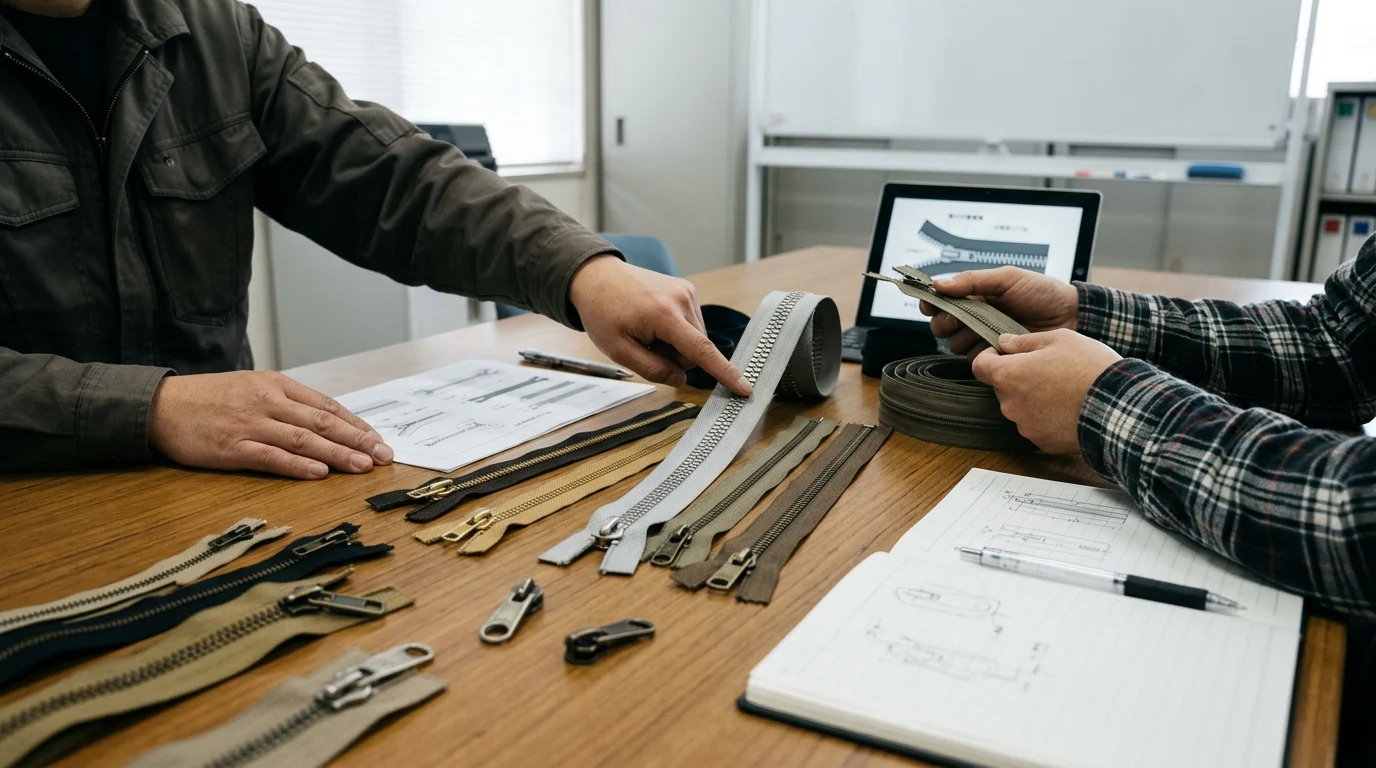
The fundamental architecture of a zipper dictates its mechanical limits and ideal use cases. In heavy-duty applications, manufacturers typically specify gauge sizes ranging from #8 to #20, where the numerical value roughly correlates to the width of the closed zipper chain in millimeters. Selecting the correct type and size is the baseline for ensuring long-term durability.
Metal vs molded plastic vs coil zippers
The three primary zipper categories—metal, molded plastic, and coil—each possess distinct mechanical profiles. Metal zippers utilize individual teeth stamped from brass, aluminum, or nickel, offering exceptionally high rigid strength but limited flexibility. Molded plastic (often referred to as Vislon) zippers feature polyoxymethylene (POM) teeth injected directly onto the tape, providing excellent weather resistance and a smooth glide.
Coil zippers are formed from a continuous monofilament of nylon or polyester sewn onto the tape. They deliver superior lateral flexibility, are highly resistant to horizontal stress, and possess a unique self-healing property where derailed coils can often be realigned by moving the slider back and forth.
| Zipper Type | Primary Material | Crosswise Strength | Flexibility | Best Environment |
|---|---|---|---|---|
| Metal | Brass / Nickel / Aluminum | Very High | Low | High heat, heavy abrasion |
| Molded Plastic | Polyoxymethylene (POM) | High | Moderate | Saltwater, mud, UV exposure |
| Coil | Nylon / Polyester | Very High | Very High | Curved paths, overstuffed bags |
Components that determine long-term durability
Long-term durability hinges on three primary components: the tape, the elements (teeth or coils), and the slider. Heavy-duty tapes are woven from high-denier polyester, or occasionally aramid fibers, to prevent tearing under heavy loads. The weave density must be tight enough to anchor the elements securely over thousands of uses.
Sliders are the most frequently manipulated component and must be die-cast from high-grade zinc alloys. A structurally sound heavy-duty slider is engineered to endure a minimum of 10,000 to 15,000 reciprocating cycles without structural fatigue or widening of the slider mouth, which is a common cause of chain separation.
Key durability comparison criteria
When comparing zippers for heavy-duty bags, engineers look at specific, quantifiable metrics. Crosswise strength (the force required to pull the interlocked teeth apart laterally) is critical; a premium #10 zipper should demonstrate a crosswise strength of at least 1,000 N.
Other vital criteria include slider pull-off strength (resistance to the slider being ripped off the chain) and operating force (the friction resistance during opening and closing). Zippers that maintain a low operating force while delivering high crosswise strength generally offer the longest lifespan in the field.
Factors That Affect Zipper Lifespan
A zipper’s lifespan is rarely determined by age alone; it is a function of mechanical stress, environmental exposure, and the quality of its integration into the bag. Even the highest-grade closures will fail prematurely if subjected to conditions beyond their specified tolerances.
Chain size, material grade, slider design, and stitching
The interplay between chain size, material grade, and construction methods dictates overall resilience. Upgrading a bag’s design from a #5 to a #10 chain size can increase burst strength by over 150%. However, this larger chain requires a proportionately robust slider to prevent torque-induced derailment.
Integration is equally critical. Stitching density plays a massive role in zipper lifespan; heavy-duty applications generally require 7 to 9 stitches per inch (SPI). Using bonded nylon or Kevlar thread prevents the zipper tape from detaching from the bag fabric under heavy sheer loads. If the stitching fails, the zipper’s internal strength becomes irrelevant.
Stress differences across bag applications
The nature of the load heavily influences zipper wear. Static loads, such as those found in stationary storage or equipment bags, exert constant but predictable tension on the closure. Zippers in these applications primarily need high static burst strength to prevent creep over time.
Conversely, dynamic loads—common in expedition backpacks, tactical duffels, and courier bags—generate severe shock loads. As a heavy bag is dropped or hoisted, the instantaneous force on the zipper chain can peak violently, occasionally exceeding 800 N. Zippers in dynamic applications require higher flexibility, making heavy-duty nylon coil closures particularly effective.
Effects of moisture, contamination, salt, and overpacking
Environmental degradation severely curtails zipper lifespans if the wrong material is selected. Marine environments induce dezincification in brass zippers, causing the teeth to become brittle and snap. In desert or construction environments, sand and silica dust act as abrasives, wearing down the continuous filament in coil zippers and increasing the operating force until the slider jams.
Temperature extremes also play a role. Molded plastic (POM) zippers are highly resilient to UV radiation and maintain their structural integrity and operability in extreme temperature bands ranging from -40°C to 80°C. Additionally, frequent overpacking forces the slider to operate at an angle, grinding the internal rails and leading to premature slider mouth expansion.
How to Evaluate and Source Heavy-Duty Zippers
Sourcing reliable closure systems requires rigorous qualification protocols. Partnering with an experienced manufacturer that understands the nuances of a heavy duty zipper and its engineering mitigates downstream failures and ensures consistent quality across production runs.
Practical testing methods for buyers and manufacturers
Buyers and manufacturers must mandate standardized testing to verify performance claims. The most universally recognized standards are ASTM D2061 for strength tests and ASTM D2062 for operability. These tests measure precise failure points under controlled laboratory conditions.
The reciprocating test is the most practical indicator of lifespan. In this test, a machine repeatedly opens and closes the zipper under lateral tension. A true heavy-duty zipper must complete a minimum of 5,000 cycles without element separation, tape fraying, or slider lockup. Many premium closures are engineered to surpass 10,000 cycles without significant degradation.
How to assess supplier quality and consistency
Supplier consistency is evaluated through strict Acceptable Quality Limit (AQL) standards. For mission-critical bag hardware, an AQL of 1.0 or 1.5 for major defects is standard practice. This ensures that dimensional tolerances remain strict across massive production batches.
For example, the slider gap clearance—the internal space where the teeth interlock—is often machined to tolerances within 0.05 mm. If a supplier lacks the ISO 9001 certified quality management systems to maintain this precision, the resulting zippers will suffer from inconsistent glide and unpredictable burst strengths.
Compliance, specifications, and documentation checks
Documentation must verify regulatory and environmental compliance, particularly for bags intended for global distribution. Key certifications include OEKO-TEX Standard 100, which ensures the textiles are free from harmful substances, and REACH compliance for the European market.
Heavy metal content is a critical compliance checkpoint. Lead, frequently found in the paint or electroplating of lower-quality sliders, must test below 90 ppm (parts per million) to meet international safety and import regulations. Buyers should always request updated laboratory test reports to verify these specifications before committing to bulk orders.
Choosing the Best Long-Term Option
Selecting the optimal closure system is a balancing act between mechanical requirements, environmental exposure, and budget constraints. No single zipper type is universally superior; longevity is achieved by matching the zipper’s specific material properties to the bag’s intended end-use.
When metal is the best choice
Metal zippers remain the premier choice for applications where aesthetic weight, rigid structure, and high heat resistance are paramount. They are the standard for premium heavy-leather goods and heavy canvas workwear bags.
Crucially, metal is indispensable in flame-retardant (FR) applications. For bags utilized by firefighters or welders, brass or nickel zippers can withstand ambient temperatures exceeding 200°C—environments where synthetic polymer elements would melt and fuse, rendering the bag permanently sealed.
When plastic or coil is the better option
Molded plastic is the superior choice for marine, winter sports, and outdoor gear exposed to corrosive salt, mud, and ice. The robust, self-lubricating nature of POM teeth prevents freezing and allows the zipper to clear debris easily during operation.
Nylon coil zippers dominate applications requiring curved closures, such as the rounded compartments of tactical backpacks. Because of their continuous filament structure, coil zippers can bend around tight radiuses without element separation and can efficiently handle transverse stress up to 600 N, making them ideal for overstuffed compartments.
A decision framework for zipper selection
A systematic decision framework aligns zipper specifications with bag utility. Designers must map the primary environmental stressor (e.g., UV exposure, curve radius, or load mass) against the zipper’s mechanical profile to ensure maximum longevity.
| Primary Bag Application | Dominant Stress Factor | Recommended Zipper Type | Recommended Minimum Gauge |
|---|---|---|---|
| Tactical / Overpacked Backpacks | High burst pressure, curved paths | Heavy-Duty Nylon Coil | #8 to #10 |
| Marine / Scuba Gear Bags | Saltwater corrosion, sand | Molded Plastic (Vislon) | #10 to #15 |
| Industrial Tool / Leather Bags | Heavy static loads, abrasion | Metal (Brass/Nickel) | #10 |
| Fire / Welding Equipment | Extreme heat (>200°C) | Metal on Nomex Tape | #8 to #10 |
By adhering to these matching principles and demanding rigorous testing data, manufacturers can virtually eliminate premature closure failures. For specialized procurement guidance, technical buyers can contact us to verify specifications and source the exact hardware required for their heavy-duty applications.
Further reading:
Key Takeaways
- The most important conclusions and rationale for heavy duty zipper
- Specs, compliance, and risk checks worth validating before you commit
- Practical next steps and caveats readers can apply immediately
Frequently Asked Questions
Which zipper type usually lasts longest on heavy-duty bags?
For most heavy-duty bags, molded plastic and coil zippers often outlast metal because they handle flex, overpacking, and repeated cycles better. Metal is strongest for abrasion and heat but can be less forgiving on curved openings.
Is a larger zipper size always more durable?
Not always. A bigger gauge like #10 or above generally improves strength, but durability also depends on tape quality, slider construction, and bag design. Match size to load, opening length, and expected stress.
What causes heavy-duty zipper failure most often?
The most common issues are slider wear, tape tearing, and chain separation from overload. Overstuffing, side stress, dirt, and poor alignment accelerate failure, even when the bag fabric still looks fine.
Which zipper is best for outdoor or marine heavy-duty bags?
Molded plastic zippers are usually the best choice for marine or outdoor bags because they resist saltwater, mud, and UV exposure. They also glide smoothly and are less likely to corrode than metal.
How can manufacturers reduce zipper-related warranty claims?
Use the correct zipper gauge, reinforced tape, and a high-grade die-cast slider rated for repeated cycles. On TramigoBlog product-focused applications, choosing zippers based on load and environment helps reduce early bag failure.


