
Introduction
Choosing between nylon and polyester webbing affects more than material preference; it directly influences strength retention, stretch behavior, weather resistance, and long-term cost. Although both are widely used in load-bearing and industrial applications, they respond differently to moisture, UV exposure, abrasion, and repeated stress. This comparison explains where each material performs best, what trade-offs matter most, and how those differences can impact safety, service life, and purchasing decisions. With that context, the rest of the article examines the key performance factors that determine which webbing is the better fit for a specific job.
Why the Nylon vs Polyester Webbing Choice Matters
Selecting the correct textile for load-bearing and environmental applications is a critical engineering decision. The debate between nylon and polyester webbing dominates discussions in industries ranging from cargo transportation to personal protective equipment.
Understanding the fundamental differences between these two synthetic polymers ensures safety standards are met while optimizing procurement budgets. Both materials offer exceptional strength-to-weight ratios, but their distinct chemical structures yield vastly different behaviors under stress and environmental exposure.
Application requirements and risk exposure
Every application carries a unique risk profile dictated by environmental exposure and mechanical stress. When engineering a product requiring structural integrity, failing to match the webbing material to its operational environment can lead to catastrophic failures. For instance, heavy-duty industrial applications often require webbing with a minimum tensile strength exceeding 5,000 lbs (22.2 kN) to meet occupational safety mandates.
Risk exposure extends beyond sheer breaking strength. Factors such as dynamic loading, continuous abrasion, and prolonged exposure to ultraviolet radiation must also dictate the material selection process. A material that performs flawlessly in a climate-controlled warehouse may degrade rapidly when subjected to marine environments or high-altitude solar radiation.
Common purchasing mistakes and hidden costs
A frequent procurement misstep is prioritizing initial unit cost over lifecycle durability. Buyers often specify nylon due to its historical reputation for strength, without accounting for its susceptibility to environmental degradation. This oversight can result in hidden costs, such as premature replacement cycles and increased liability from degraded equipment in the field.
To mitigate these purchasing errors, sourcing professionals must rigorously evaluate product specifications against the intended use case. Specifying an over-engineered material for a low-risk application unnecessarily inflates production costs, while under-specifying leads to product recalls, warranty claims, and severe safety hazards.
Nylon and Polyester Webbing Basics
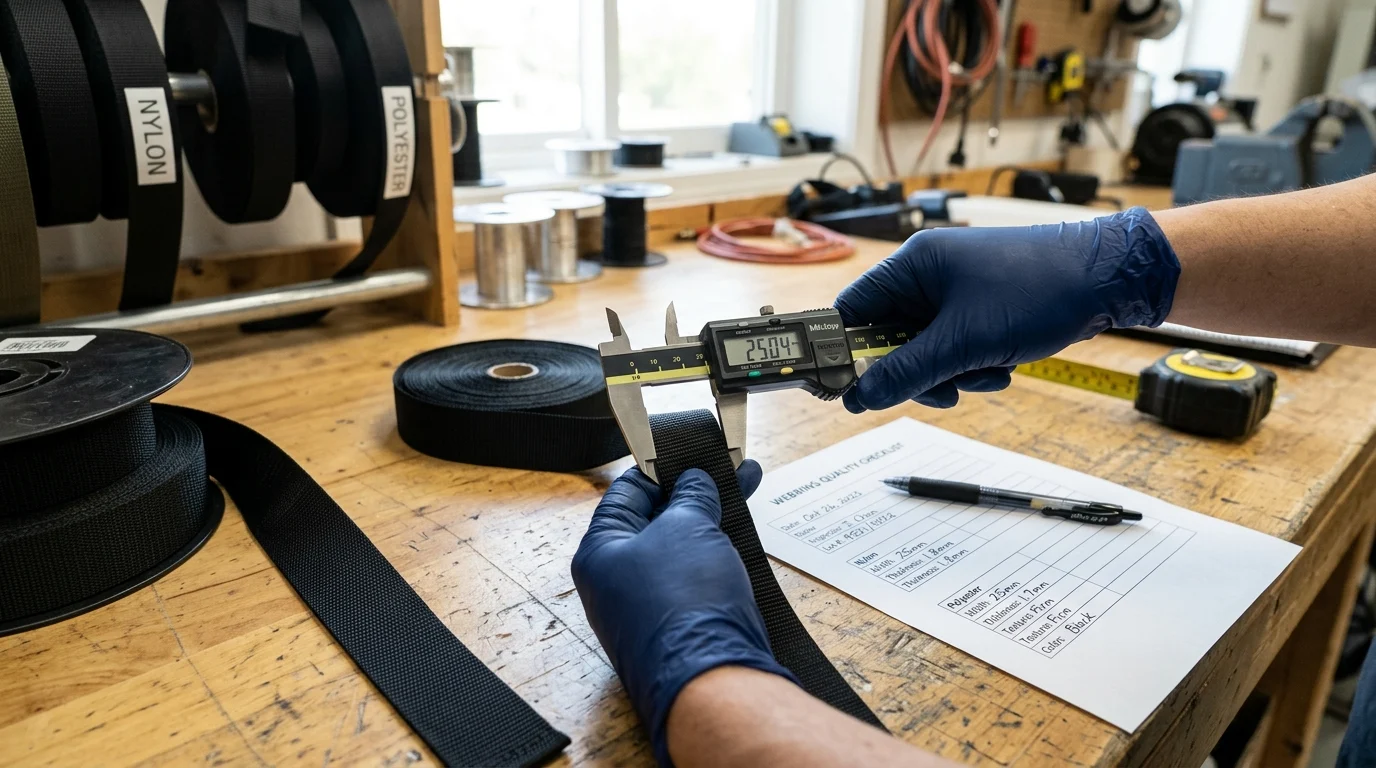
At the microscopic level, nylon (polyamide) and polyester (polyethylene terephthalate) are distinctly different synthetic polymers. Their manufacturing processes and chemical compositions directly dictate their physical characteristics, ranging from texture and flexibility to thermal stability.
Engineers and product designers must look beyond basic tensile strength and examine the core properties of the yarn used in the weaving process to accurately predict how the finished webbing will perform.
How each material is made and specified
Both nylon and polyester webbing begin as thermoplastic chips that are melted and extruded into continuous filament yarns. These yarns are then woven together on specialized needle looms. The density and strength of the webbing are largely determined by the yarn’s denier, which commonly ranges from 500D to 1500D for industrial applications.
Nylon is typically specified as either Nylon 6 or Nylon 6,6, with the latter offering a tighter molecular structure and higher thermal resistance. Polyester, on the other hand, is inherently hydrophobic during the extrusion process, meaning its resistance to moisture is a structural characteristic rather than an applied surface treatment.
Key properties that affect performance
The chemical structure of nylon allows for significant molecular elongation, granting the material a soft, supple feel and high elasticity. However, this same structure features hydrophilic properties, causing the fibers to absorb moisture from the surrounding environment. Nylon’s melting point sits at approximately 480°F to 500°F (249°C to 260°C), making it suitable for moderate-friction applications.
Polyester features a more rigid molecular alignment. This results in a stiffer webbing that resists stretching and maintains its dimensional stability under tension. Polyester exhibits a slightly higher melting point, generally around 500°F to 520°F (260°C to 271°C), and boasts superior inherent resistance to ultraviolet light degradation.
Comparison table essentials
To simplify the material selection process, the structural and performance differences between nylon and polyester can be quantified across several key metrics. The following table outlines the foundational properties of standard industrial-grade webbing.
| Property | Nylon Webbing | Polyester Webbing |
|---|---|---|
| Polymer Base | Polyamide | Polyethylene Terephthalate |
| Elongation at Break | High (20% – 30%) | Low (5% – 15%) |
| Water Absorption | High (Up to 10% of weight) | Very Low (< 1%) |
| UV Resistance | Moderate (Degrades over time) | Excellent |
| Abrasion Resistance | Excellent | Very Good |
Real-World Performance Differences
Theoretical properties observed in laboratory settings translate into highly tangible performance differences in the field. The choice between nylon and polyester dramatically alters how a finished product handles physical loads, harsh climates, and chemical exposure.
By analyzing real-world operational environments, procurement teams can align material capabilities with end-user expectations, ensuring maximum safety and operational efficiency.
Load handling and shock absorption
When subjected to heavy loads, nylon webbing exhibits significant elasticity, stretching up to 30% at its breaking point. This high elongation rate makes nylon an exceptional shock absorber. In applications where sudden dynamic forces are applied—such as a falling climber or a vehicle recovery operation—nylon dissipates kinetic energy, reducing the shock transmitted to the anchor points and the user.
Conversely, polyester webbing is designed for static load management. With an elongation rate typically confined to 5% to 15%, polyester holds heavy cargo securely without slackening over time. This dimensional stability is vital for tie-down straps and ratchet systems, where any stretch in the webbing could result in a shifted and dangerous payload during transit.
Moisture, UV, chemicals, and temperature resistance
Environmental exposure highlights the most severe divergence between the two materials. Nylon is highly hydrophilic; when fully saturated, it can absorb up to 10% of its weight in water. This acts as a plasticizer and can reduce the material’s tensile strength by as much as 15% to 20% while wet. Furthermore, prolonged exposure to UV radiation causes nylon fibers to become brittle and lose structural integrity.
Polyester excels in harsh outdoor environments. Because it absorbs virtually no water, polyester webbing retains 100% of its dry strength even in torrential rain or marine environments, and it resists rot, mildew, and freezing. Additionally, polyester possesses high resistance to acidic chemicals, whereas nylon is generally preferred in environments exposed to alkalis.
Best-fit use cases for each material
Based on these performance metrics, specific industries naturally gravitate toward one material over the other. Nylon is the undisputed standard for life-safety equipment involving dynamic falls, such as climbing harnesses, military parachute rigging, and heavy-duty towing straps where energy absorption is paramount.
Polyester dominates the logistics and transportation sectors. It is the optimal choice for flatbed truck tie-downs, marine rigging, sailcloth reinforcements, and outdoor tent tensioning systems. Any application requiring long-term outdoor exposure and unyielding load security is best served by polyester webbing.
Cost, Sourcing, and Quality Control
Beyond mechanical properties, procuring industrial webbing involves navigating a complex landscape of pricing, quality assurance, and global supply chains.
Ensuring consistent material performance requires buyers to scrutinize their sourcing partners and demand rigorous documentation for every batch of webbing produced.
Price drivers and manufacturing variables
The pricing of synthetic webbing is directly tied to global petrochemical markets. Historically, nylon raw materials are more expensive to synthesize than polyester, resulting in finished nylon webbing commanding a price premium of 20% to 30% over comparable polyester products. This cost delta becomes highly significant when scaling up to mass production runs.
Manufacturing variables also impact the final price. Custom dyeing, specialized weaving patterns (such as tubular versus flat webbing), and secondary treatments like resin coatings for increased abrasion resistance all add to the unit cost. Manufacturers must balance these enhancements against the target budget of the final product.
Supplier qualification and strength verification
Selecting a reliable manufacturing partner is critical to maintaining supply chain integrity. Industrial buyers should evaluate company backgrounds and capabilities to ensure the supplier operates with modern needle looms and automated tensioning controls. Inconsistent weaving tension can lead to hidden weak points that drastically lower the overall breaking strength of the strap.
Commercial sourcing also requires managing Minimum Order Quantities (MOQs). For standard colors like black or white, MOQs might be as low as 1,000 meters. However, for custom Pantone-matched colors or specialized tensile requirements, suppliers typically require MOQs ranging from 3,000 to 5,000 meters to justify the setup costs of the extrusion and dyeing equipment.
Testing, compliance, and documentation
Quality control in the webbing industry relies on destructive testing and adherence to international standards. Reputable suppliers utilize computerized tensile testing machines to verify that production batches meet or exceed specified breaking strengths. For safety equipment, standards such as ISO 105-B02 for colorfastness to light and ASTM D6770 for webbing abrasion resistance are frequently mandated.
Buyers must insist on receiving Certificates of Analysis (CoA) or test reports with every shipment. For military and defense contractors, compliance with specific regulations, such as the Berry Amendment in the United States, requires rigorous documentation proving domestic sourcing and manufacturing of the synthetic yarns.
How to Choose the Right Webbing
Synthesizing the data into a final procurement decision requires a structured approach. The choice between nylon and polyester webbing should never be based on personal preference or historical habit, but rather on a systematic evaluation of the product’s lifecycle.
By categorizing the primary demands of the application, engineers and buyers can confidently select the polymer that delivers the optimal balance of safety, durability, and cost-effectiveness.
Choosing by strength, stretch, and environment
The decision matrix ultimately revolves around three pillars: strength under dynamic versus static loads, tolerance for material stretch, and the severity of the operational environment. If the primary function of the webbing is to absorb shock and protect a user from a sudden jolt, nylon is the mandatory choice due to its high elongation properties.
Conversely, if the webbing must secure a heavy load without yielding, or if the product will spend its entire lifecycle outdoors exposed to rain and intense sunlight, polyester provides unmatched reliability. Failing to align the material with these three pillars guarantees premature product failure.
Step-by-step selection framework
To streamline the specification process, procurement teams can utilize a straightforward selection framework. First, define the maximum anticipated load and whether that load is static or dynamic. Second, assess the environmental exposure—specifically UV light, moisture, and chemical contact. Third, consult with textile engineers or reach out to supplier representatives to determine if secondary treatments (like water repellents) are necessary. Finally, evaluate the cost implications against the target retail price.
| Application Requirement | Recommended Material | Primary Justification |
|---|---|---|
| Fall Arrest / Shock Absorption | Nylon | High stretch (20-30%) safely dissipates kinetic energy. |
| Cargo Tie-Downs / Ratchets | Polyester | Low stretch (5-15%) keeps static loads firmly secured. |
| Marine / Prolonged Outdoor Use | Polyester | Near-zero water absorption and superior UV resistance. |
| High-Abrasion Indoor Use | Nylon | Excellent surface durability and supple handling characteristics. |
Further reading:
Key Takeaways
- The most important conclusions and rationale for nylon webbing vs polyester webbing
- Specs, compliance, and risk checks worth validating before you commit
- Practical next steps and caveats readers can apply immediately
Frequently Asked Questions
Which webbing is better for outdoor and marine use?
Polyester is usually better because it absorbs very little water and has stronger UV resistance, so it holds up longer in sun, rain, and salt-air exposure.
When should I choose nylon webbing instead of polyester?
Choose nylon when you need higher flexibility and strong abrasion resistance, such as straps exposed to repeated rubbing or applications where some stretch helps absorb shock.
Does nylon webbing lose performance when wet?
Yes. Nylon can absorb up to about 10% of its weight in water, which can affect handling and long-term durability. For wet environments, polyester is often the safer choice.
Why is polyester webbing often preferred for low-stretch applications?
Polyester stretches less under load, so it maintains size and tension better. That makes it practical for tie-downs, cargo restraint, and other applications needing dimensional stability.
How can buyers avoid costly webbing selection mistakes?
Match the webbing to the actual environment and load: check tensile strength, UV exposure, moisture, and abrasion needs against supplier specifications before purchasing.


