
Introduction
In harsh service conditions, the adhesive on reflective tape often fails before the reflective layer does, turning a visibility product into a maintenance problem. Choosing the right reflective tape adhesive means looking beyond initial stickiness to long-term resistance against UV exposure, temperature cycling, moisture, chemicals, and substrate movement. This article explains which adhesive types perform best in demanding environments, what failure modes to watch for, and how surface material and application conditions affect bond strength. By the end, you’ll be better equipped to compare options and select reflective tape that stays attached where durability matters most.
Why reflective tape adhesive performance determines durability
Industrial reflective tape adhesive systems are frequently the weakest link in high-visibility safety markings. While retroreflective microprisms or glass beads dictate optical performance, the adhesive backing determines the tape’s functional lifespan. Engineers must evaluate adhesive properties with the same rigor applied to retroreflectivity coefficients, as premature detachment compromises safety and triggers costly reapplication cycles.
Service conditions that weaken adhesive bonds
Reflective tapes deployed in harsh environments face continuous assault from environmental stressors. Ultraviolet radiation breaks down polymer chains in standard adhesives, leading to embrittlement. Temperature extremes cause differential thermal expansion between the tape backing, the adhesive, and the substrate. For instance, a steel substrate and a PET-backed tape expand at different rates when exposed to temperature swings from -40°C to 80°C (-40°F to 176°F), inducing severe shear stress on the adhesive layer. Additionally, chemical exposure—ranging from road salts and diesel fuel on commercial vehicles to alkaline cleaners in industrial facilities—can dissolve or plasticize inferior adhesives.
Key performance factors beyond initial tack
Buyers often mistakenly prioritize initial tack—the immediate grab of the tape upon application—over ultimate adhesion. While high initial tack simplifies installation, it does not guarantee long-term performance. Ultimate adhesion, typically achieved 72 hours post-application, measures the fully cured bond strength. Furthermore, engineers must analyze shear strength alongside peel strength. A tape applied to a vertical surface requires high static shear resistance to prevent gravitational creep over time. For demanding industrial applications, a 90-degree peel strength exceeding 50 oz/in (13.9 N/25mm) is generally established as the minimum baseline for durable performance.
Which adhesive chemistries perform best in harsh environments
Selecting the optimal adhesive chemistry requires balancing temperature resistance, substrate compatibility, and environmental stability. The chemical formulation of the adhesive dictates its viscoelastic behavior and its resistance to oxidative degradation over time.
Acrylic vs rubber vs silicone adhesives
The three primary adhesive chemistries used in reflective tapes are acrylic, rubber, and silicone. Acrylic adhesives dominate the high-performance sector due to their exceptional resistance to UV light and oxidation. They require a longer dwell time to reach maximum adhesion but offer superior longevity. Rubber-based adhesives provide aggressive initial tack and adhere well to low surface energy materials, but they degrade rapidly under UV exposure and typically fail at temperatures exceeding 60°C (140°F). Silicone adhesives are reserved for extreme environments, maintaining flexibility and bond strength from -50°C up to 200°C (-58°F to 392°F), though they command a significant price premium.
| Adhesive Chemistry | Temperature Range | UV Resistance | Chemical Resistance | Relative Cost |
|---|---|---|---|---|
| Acrylic | -30°C to 120°C | Excellent | High | Medium |
| Rubber | -10°C to 60°C | Poor | Low | Low |
| Silicone | -50°C to 200°C | Excellent | Excellent | High |
Construction details that affect long-term performance
Long-term performance is not solely dependent on the chemical base; the physical construction of the adhesive layer is equally critical. The adhesive coat weight, measured in microns or grams per square meter (gsm), directly influences how well the tape wets out on textured surfaces. Standard smooth substrates may only require a 25-micron adhesive layer, while diamond-plate aluminum or porous concrete demands coat weights exceeding 50 microns to fill microscopic voids and maximize contact area. Additionally, the integration of a reinforcing scrim within the adhesive can improve dimensional stability and prevent the tape from stretching during application.
Comparison criteria for evaluating options
When evaluating different adhesive options, engineers must compare cross-linking density and viscoelasticity. High cross-linking density improves shear strength and chemical resistance but can reduce the adhesive’s ability to flow into substrate micro-crevices. Viscoelasticity—the adhesive’s ability to act as both a viscous liquid and an elastic solid—determines how well the bond absorbs impact and vibration. A properly balanced viscoelastic profile allows the adhesive to dissipate mechanical stress without fracturing, which is essential for tapes applied to heavy machinery or commercial transport fleets subject to constant road vibration.
How to match adhesive to substrates and application conditions
The interface between the adhesive and the mounting surface ultimately governs bond strength. Even the most advanced adhesive formulation will fail if the substrate surface energy is incompatible or if application protocols are ignored.
High-risk substrates and surface challenges
Surface energy, measured in dynes/cm, is the primary metric for predicting adhesive wet-out. High Surface Energy (HSE) materials like bare aluminum and stainless steel (both >400 dynes/cm) readily accept most adhesives. Conversely, Low Surface Energy (LSE) plastics present significant adhesion risks. High-Density Polyethylene (HDPE) at 36 dynes/cm and Polypropylene at 29 dynes/cm repel standard acrylic adhesives. Bonding to these substrates requires specially modified, tackified acrylics or the application of a chemical adhesion promoter. Powder-coated metals also present a challenge, as the slick, hydrophobic nature of the powder coat behaves similarly to LSE plastics.
Application steps that improve bond strength
Rigid adherence to surface preparation and application protocols can increase ultimate bond strength by up to 40%. Substrates must be degreased and cleaned, typically using a 50/50 mixture of isopropyl alcohol (IPA) and water, to remove invisible surface contaminants. Application temperature is a critical variable; applying tape below 10°C (50°F) causes the adhesive to stiffen, preventing adequate wet-out. Finally, mechanical pressure is required to activate pressure-sensitive adhesives (PSAs). Applying firm, even pressure of at least 15 psi using a squeegee or roller ensures that the microscopic adhesive polymers intimately contact the substrate topography, eliminating air pockets that could trap moisture.
When removable adhesives are the right choice
While maximum durability is the goal for permanent markings, temporary applications necessitate removable adhesives. Scenarios such as temporary traffic control, construction zone delineation, and short-term vehicle leasing require tapes that stay firmly in place but detach cleanly when required. For an adhesive to be cleanly removable, its cohesive strength (internal bond) must exceed its adhesive strength (bond to the substrate). Removable formulations are engineered to provide a controlled peel force—typically between 10 to 20 oz/in—allowing the tape to be stripped away without leaving residue or damaging the underlying clear coat, even after 12 months of exterior exposure.
What compliance and supplier quality indicators matter
Procurement teams must verify that the reflective tape adhesive meets stringent regulatory benchmarks and quality control standards. Relying on unverified supplier claims introduces severe liability risks in critical safety infrastructure.
Relevant standards and test methods
Standardized testing provides objective data for comparing adhesive performance. ASTM D3330 evaluates peel adhesion to standard steel substrates, while ASTM D3654 measures static shear adhesion under a constant load. For commercial transport, the Federal Motor Vehicle Safety Standard (FMVSS) 108 and DOT-C2 regulations require reflective markings to withstand rigorous environmental weathering and maintain adhesion for a minimum lifespan of 7 years. Tape adhesives evaluated for marine environments must pass ASTM B117 salt spray testing to ensure the bond does not degrade under continuous saline exposure.
How to assess supplier quality and consistency
Assessing a supplier’s quality control infrastructure is vital for ensuring batch-to-batch consistency. Buyers should look for ISO 9001 certification and request statistical process control (SPC) data for critical manufacturing parameters. Coat weight consistency is a primary indicator of manufacturing maturity; a Process Capability Index (Cpk) greater than 1.33 indicates a highly controlled coating process. Furthermore, acceptable defect rates for industrial-grade reflective tapes should be maintained below 500 Parts Per Million (PPM). Suppliers failing to provide comprehensive technical data sheets (TDS) or material safety data sheets (MSDS) should be disqualified.
Regional sourcing and logistics risks
Global sourcing introduces logistical variables that can compromise adhesive integrity before the tape is even applied. Pressure-sensitive adhesives have a finite shelf life. High-performance acrylic adhesives typically boast a shelf life of 12 to 24 months when stored in climate-controlled environments at 21°C (70°F) and 50% relative humidity. However, extended transit times in unventilated shipping containers can subject the tape to temperatures exceeding 50°C (122°F). Such temperature excursions can cause the adhesive to prematurely cross-link or ooze from the roll edges, rendering the tape unusable upon arrival.
How to choose the best reflective tape adhesive
Integrating technical specifications into a structured procurement framework ensures that engineers and buyers select the optimal reflective tape adhesive for their specific operational demands. A systematic approach mitigates the risk of catastrophic bond failure in the field.
A decision framework for buyers and engineers
A robust decision framework maps operational environments against substrate types to identify the required adhesive chemistry. Buyers must define the expected service life, the ambient temperature range, and the chemical exposures the tape will endure.
| Application Environment | Primary Substrate | Recommended Adhesive | Expected Lifespan |
|---|---|---|---|
| Indoor Warehouse | Clean Steel / Concrete | Standard Acrylic | 5-10 Years |
| Outdoor Transport | Painted Aluminum | High-Tack Acrylic | 7-10 Years |
| Extreme Industrial | LSE Plastics (HDPE) | Modified Acrylic / Rubber | 3-5 Years |
| High Heat / Marine | Stainless Steel | Silicone | 5+ Years |
By cross-referencing these variables, procurement teams can right-size their specifications, avoiding the unnecessary expense of silicone adhesives where a standard acrylic would suffice, while preventing the under-specification of rubber adhesives in high-UV outdoor applications.
Failure patterns that signal a poor adhesive match
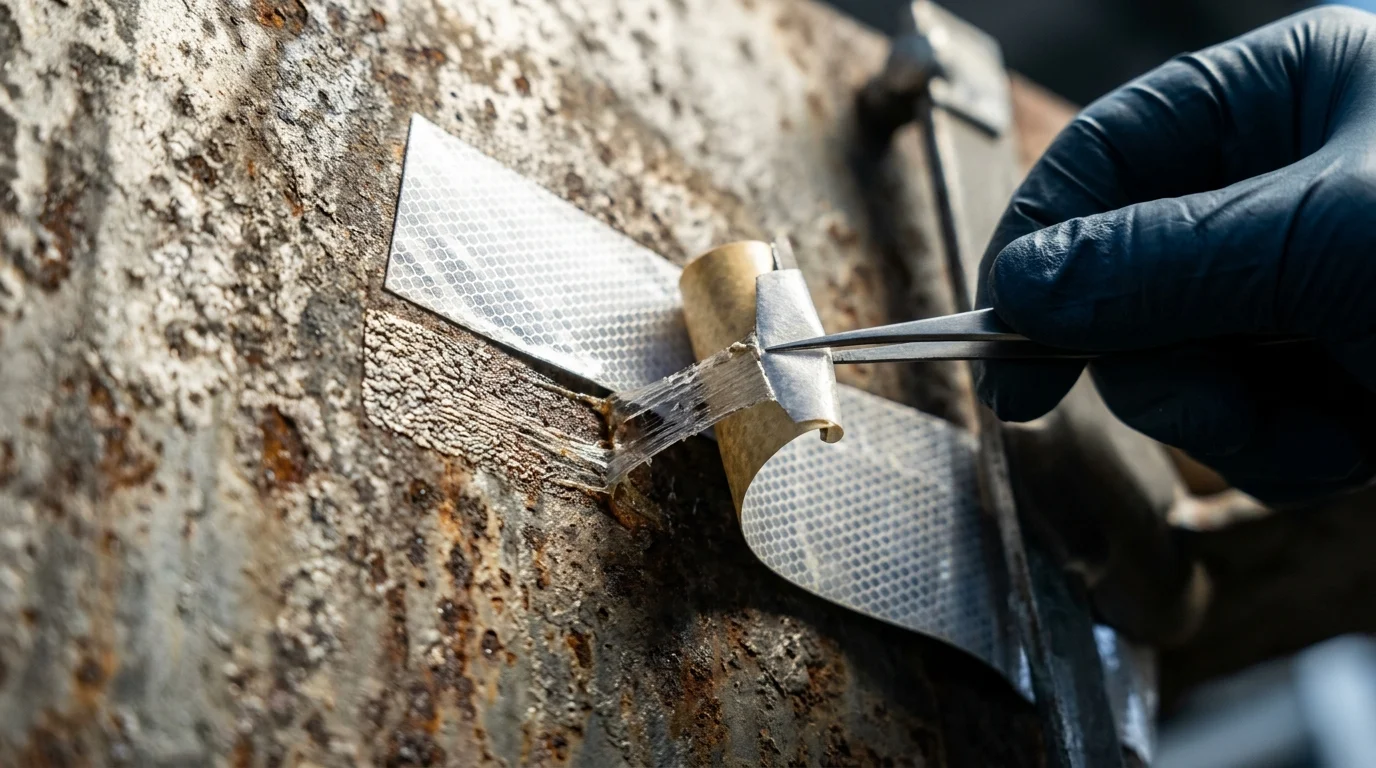
Recognizing and analyzing failure patterns is crucial for correcting adhesive mismatches. “Flagging,” where the edges of the tape lift away from the surface, indicates that the adhesive’s shear strength is insufficient to overcome the physical memory (stiffness) of the tape backing. Blistering beneath the tape often points to outgassing from polycarbonate or plasticized PVC substrates reacting with an incompatible adhesive. Cohesive failure—where the adhesive splits internally, leaving sticky residue on both the tape backing and the substrate—signals that the adhesive polymer matrix has been degraded by environmental factors or chemical exposure. Analyzing these failures via a 180-degree peel test helps engineers adjust their specifications for future procurement cycles.
Further reading:
Key Takeaways
- The most important conclusions and rationale for reflective tape adhesive
- Specs, compliance, and risk checks worth validating before you commit
- Practical next steps and caveats readers can apply immediately
Frequently Asked Questions
Which reflective tape adhesive is best for outdoor vehicles and trailers?
Acrylic adhesive is usually the best fit. It handles UV, road salt, diesel splash, and wide temperature swings better than rubber-based options.
When should I choose silicone reflective tape adhesive?
Use silicone when surfaces face extreme heat or cold, roughly -50°C to 200°C. It costs more, but it keeps bond strength where standard acrylics may struggle.
Is high initial tack enough for harsh-environment reflective tape?
No. Initial tack helps installation, but long-term durability depends more on ultimate adhesion, shear strength, and resistance to UV, chemicals, and temperature cycling.
How long should reflective tape adhesive cure before full performance?
Plan for about 72 hours to reach ultimate adhesion. Keep the tape clean, dry, and firmly pressed during that dwell period for best results.
What adhesive construction works better on textured metal or concrete?
Choose a heavier adhesive coat weight, often over 50 microns, so it can fill surface irregularities. This improves wet-out and reduces early edge lift on rough substrates.


