
Introduction
Choosing between reflective and standard webbing affects more than appearance in outdoor products; it changes how gear performs in low light, how much it costs to produce, and where it fits in the market. For items like pet accessories, running gear, and cycling bags, added visibility can be a practical safety feature rather than a cosmetic upgrade. This article explains the key differences in visibility, durability, handling, and pricing, and shows when reflective webbing delivers clear value over standard options. It also helps you weigh those tradeoffs against product goals, customer expectations, and sourcing decisions before moving into detailed material comparisons.
Why Reflective Webbing vs Standard Webbing Matters
In the competitive landscape of outdoor gear manufacturing, material selection directly impacts product performance and end-user safety. Upgrading to retroreflective materials can increase nighttime visibility ranges up to 300 meters—a crucial threshold for pedestrian and cyclist safety. However, this upgrade introduces new considerations in procurement, cost, and material handling.
Understanding the technical and commercial implications of reflective webbing vs standard webbing is essential for product managers and procurement teams. Selecting the right strap or binding material requires balancing regulatory compliance, consumer demand for safety features, and strict manufacturing budgets.
Outdoor products that benefit most
Integrating reflective elements is highly advantageous for specific categories of outdoor gear. Pet collars, leashes, and harnesses represent one of the largest market segments demanding high-visibility textiles, driven by consumer concerns for animal safety during evening walks. Similarly, running vests, cycling backpacks, and tactical outdoor gear rely on reflective textiles to prevent accidents in low-light environments. Manufacturers exploring diverse products often find that adding reflective trim to these items justifies a premium retail price.
When visibility changes buying priorities
Consumer buying priorities shift dramatically when safety becomes a primary concern. In urban commuting and nighttime outdoor recreation, visibility is no longer viewed as an optional aesthetic feature but as a mandatory functional requirement. This shift is often reinforced by safety standards, such as the ISO 20471 requirements for high-visibility clothing and accessories. When target demographics prioritize twilight or nocturnal activities, the inclusion of reflective webbing transitions from a secondary feature to a core selling point that drives purchasing decisions.
Key Differences Between Reflective and Standard Webbing

While both types of webbing serve the fundamental purpose of load-bearing and fastening, their physical compositions differ significantly. Standard webbing relies solely on the strength and weave of base polymers, whereas reflective webbing must integrate fragile retroreflective technologies without compromising structural integrity.
Materials and construction
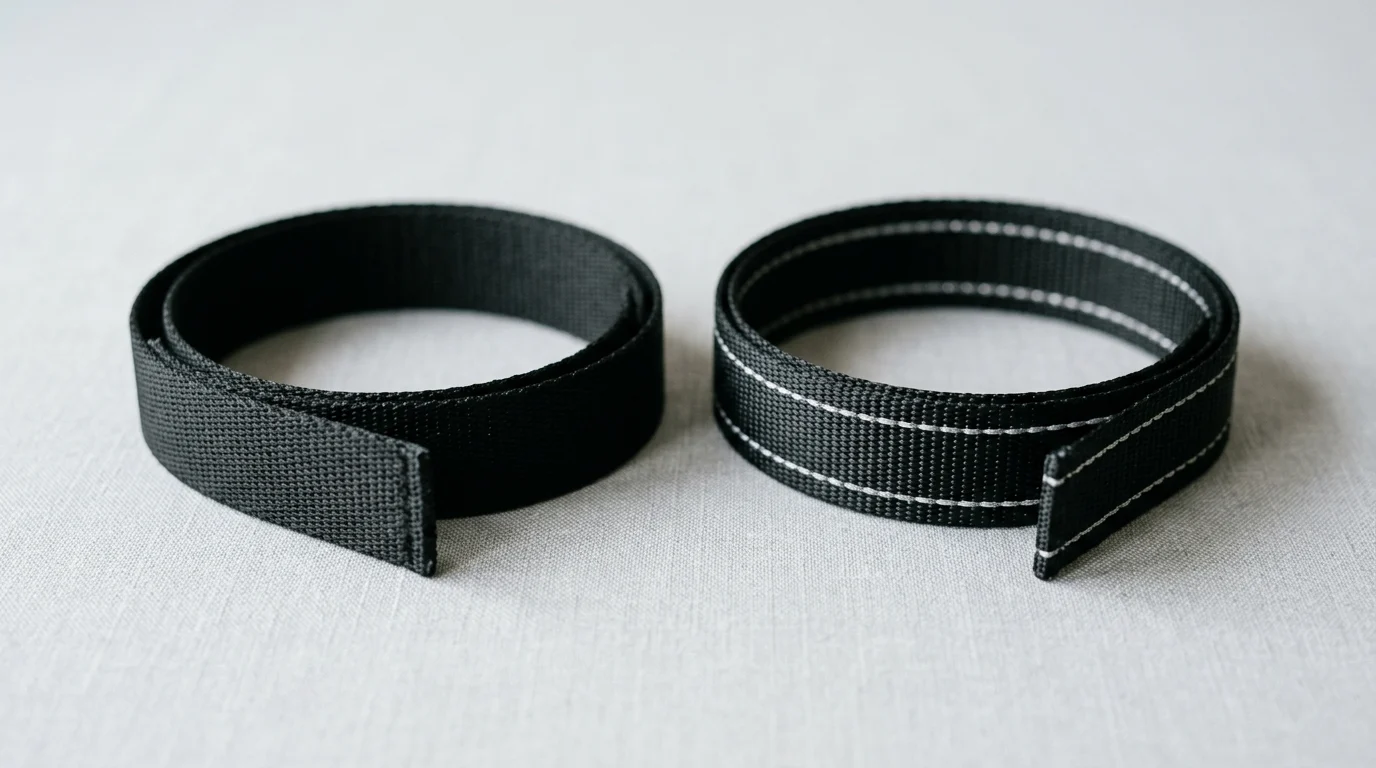
Standard webbing is typically woven from high-tenacity nylon, polyester, or polypropylene yarns. These materials offer consistent dye absorption and straightforward weaving processes. Reflective webbing, by contrast, incorporates specialized yarns coated with microscopic glass beads or microprismatic vinyl. These reflective threads can be interwoven directly into the fabric matrix, sewn on as a secondary reflective tape, or applied via heat transfer. Each construction method dictates the fabric’s final flexibility and abrasion resistance.
Performance in strength, visibility, and durability
Standard 1-inch heavy-duty nylon webbing can boast a tensile strength exceeding 4,000 lbs, making it ideal for high-stress applications. When reflective yarns are woven into the webbing, they often replace a portion of the load-bearing synthetic fibers. While the tensile strength reduction is usually minimal (often less than 5%), it must be accounted for in heavy-duty applications like climbing gear or automotive tie-downs. Visibility, however, is drastically improved; reflective webbing captures and returns light directly to the source, whereas standard webbing relies entirely on ambient light and color contrast.
Side-by-side comparison points
To clearly illustrate the operational differences, the following table contrasts the standard specifications of both webbing types.
| Specification | Standard Webbing (1-inch Nylon) | Reflective Webbing (1-inch Woven) |
|---|---|---|
| Tensile Strength | ~4,000 lbs | ~3,800 lbs |
| Visibility Range (Night) | < 20 meters | Up to 300 meters |
| Abrasion Resistance | Extremely High | Moderate to High (coating dependent) |
| UV Degradation | Standard polymer fading | Reflective coating may degrade faster |
| Flexibility | Highly pliable | Slightly stiffer due to reflective yarns |
Sourcing, Quality Control, and Compliance
Procuring technical textiles requires stringent oversight to ensure that safety claims hold up under real-world conditions. When sourcing reflective webbing, quality control extends beyond dimensional tolerance and color matching; it must encompass photometric performance and coating durability.
Supplier qualification questions
Evaluating a supplier for high-visibility materials requires targeted inquiries. Procurement teams must ask for the specific retroreflective index of the yarns used, which should ideally exceed 330 cd/lux/m2 for professional-grade safety gear. Furthermore, buyers should inquire about the supplier’s lamination or weaving techniques to prevent delamination. Learning about us and other industry suppliers’ manufacturing capabilities helps buyers establish benchmarks for acceptable quality and consistency.
Testing and compliance requirements
Compliance with international safety standards dictates rigorous testing protocols. Reflective webbing must undergo wash testing, commonly following the ISO 6330 standard, to ensure it maintains its luminescent properties after 25 to 50 industrial wash cycles. Additionally, standard webbing is primarily tested for colorfastness and breaking strength, whereas reflective variants must pass abrasion tests (such as the Martindale method) to verify that the glass bead coatings do not flake off when subjected to friction.
Manufacturing variables that affect consistency
Manufacturing environments introduce variables that can compromise webbing quality. Tension inconsistencies during the weaving process can cause reflective threads to snap or bunch, leading to visual defects. Furthermore, dye sublimation and heat-setting processes, which often expose the webbing to temperatures exceeding 200 degrees Celsius, must be carefully calibrated. Excessive heat can melt microprismatic tapes or dull glass-bead coatings, resulting in a batch that fails photometric compliance tests.
Cost, Logistics, and Lifecycle Trade-Offs
Transitioning from standard to reflective webbing impacts the entire supply chain, from raw material forecasting to warehouse storage. Balancing the added safety benefits against the financial and logistical trade-offs is a core responsibility for product developers.
Main cost drivers
The primary cost driver for reflective webbing is the specialized retroreflective yarn or tape, which commands a significant market premium. Consequently, reflective webbing typically costs 30% to 60% more per yard than its standard counterpart. Secondary cost drivers include slower weaving speeds required to prevent yarn breakage and higher defect rates during the quality control phase. These increased manufacturing costs must be absorbed into the final product’s bill of materials.
Lead times, storage, and maintenance
Logistical planning must accommodate differing supplier terms. Standard webbing is a ubiquitous commodity, often available with low Minimum Order Quantities (MOQs) of 500 to 1,000 meters and short lead times. Custom reflective webbing, however, frequently demands MOQs of 3,000 to 5,000 meters due to the complex setup required for specialty looms. Additionally, reflective materials have a more sensitive shelf life; prolonged exposure to high humidity or extreme warehouse temperatures can degrade the reflective adhesives over time, necessitating climate-controlled storage.
Best-fit channels and use cases
The added expense of reflective materials is best absorbed in direct-to-consumer premium channels, where safety features command higher margins. Brands producing high-end cycling panniers, professional first-responder equipment, and premium pet accessories can easily justify the cost. Conversely, for mass-market commodities competing strictly on price, or for internal structural components hidden from view, the logistical complexities and cost premiums of reflective webbing make it an inefficient choice.
How Buyers Should Choose
Making the final decision between reflective and standard webbing requires a systematic approach that aligns material specifications with end-user environments and business objectives. Procurement teams must weigh risk, cost, and functionality.
Step-by-step evaluation process
Buyers should follow a structured evaluation process. First, assess the end-user’s primary environment to determine if low-light visibility is a genuine safety requirement or merely a cosmetic addition. Second, analyze the bill of materials to see if a 15% to 20% margin impact is sustainable. Third, evaluate supplier capabilities and request wash-test certifications. Finally, conduct a small-batch prototype run to test the webbing’s flexibility and sewing behavior. For assistance in navigating this process, buyers can contact us to consult with textile engineering experts.
When reflective webbing is the better choice
Reflective webbing is the definitive choice for products deployed in high-risk, low-light environments. If a product is intended for roadside emergency kits, nighttime running apparel, or professional workwear near moving vehicles, the safety benefits far outweigh the material costs. In these applications, the webbing acts as active personal protective equipment (PPE), and failure to include it could render the product uncompetitive in a safety-conscious market.
When standard webbing is enough
Standard webbing remains the optimal choice for the vast majority of load-bearing applications where visibility is irrelevant. Internal backpack frames, heavy-duty cargo tie-downs, tent guylines used primarily in daylight, and budget-conscious promotional bags do not benefit from retroreflective technology.
| Application Scenario | Recommended Webbing | Primary Justification |
|---|---|---|
| Internal load-bearing straps | Standard | Cost efficiency; zero need for visibility |
| Nighttime pet accessories | Reflective | Critical safety feature for consumer peace of mind |
| Industrial cargo tie-downs | Standard | Maximum tensile strength required; high abrasion |
| Cycling backpacks | Reflective | Commuter safety and premium product positioning |
| Budget promotional totes | Standard | Strict margin controls and low MOQ requirements |
Further reading:
Key Takeaways
- The most important conclusions and rationale for reflective webbing vs standard webbing
- Specs, compliance, and risk checks worth validating before you commit
- Practical next steps and caveats readers can apply immediately
Frequently Asked Questions
When should I choose reflective webbing over standard webbing?
Choose reflective webbing for outdoor products used at dusk, night, or roadside, such as pet leashes, running vests, and cycling bags. Use standard webbing when visibility is not a priority.
Does reflective webbing reduce strength compared with standard webbing?
Usually only slightly. For example, 1-inch woven reflective webbing may test around 3,800 lbs versus 4,000 lbs for standard nylon, so confirm specs for heavy-duty applications.
How much more visible is reflective webbing at night?
Reflective webbing can return light visibility up to about 300 meters, while standard webbing often remains under 20 meters unless illuminated by strong ambient light.
What should buyers ask suppliers before ordering reflective webbing?
Ask for retroreflective performance data, tensile strength, abrasion and UV test results, and details on weaving or lamination methods to reduce coating failure or delamination.
Does reflective webbing help outdoor products meet safety expectations?
Yes, especially for gear marketed for low-light use. It can support visibility goals tied to standards like ISO 20471, but always verify the finished product, not just the raw webbing.


