
Introduction
Night work reduces contrast, depth perception, and reaction time, making it harder for drivers and equipment operators to spot people before it is too late. Reflective tape addresses that gap by returning light from headlights and work lamps back toward the source, helping workers stand out sooner against dark, cluttered, or weather-affected backgrounds. This article explains how reflective tape improves detection distance, why that extra visibility matters in fast-moving environments, and what factors influence its effectiveness on safety apparel so readers can better understand its role in reducing nighttime job-site risk.
How Reflective Tape Improves Worker Visibility at Night
Operating in low-light and nighttime conditions fundamentally alters workplace safety dynamics. In industries ranging from highway construction to emergency response and logistics, the inability to clearly see personnel is a primary driver of occupational hazards. Integrating high-performance reflective tape into high-visibility safety apparel (HVSA) provides a critical line of defense against vehicle and machinery collisions.
Why nighttime visibility remains a safety challenge
Despite advancements in portable site lighting and equipment headlights, nighttime visibility introduces severe operational risks. The human eye loses significant contrast sensitivity and depth perception in low light. Furthermore, driver fatigue and complex visual backgrounds—such as flashing warning lights, rain, or urban glare—can camouflage workers.
According to transportation safety data, fatal work-zone crashes occur disproportionately at night, often with vehicle speeds exceeding 50 mph. At these speeds, a driver covers approximately 73 feet per second. Without enhanced visibility measures, a worker wearing standard dark clothing might only be visible from 150 feet away, leaving the driver a mere two seconds to perceive the hazard, react, and bring the vehicle to a halt—a physical impossibility in most heavy machinery scenarios.
How reflective tape increases detection distance and contrast
Reflective materials mitigate these risks by dramatically extending the distance at which a worker can be detected. Unlike fluorescent fabrics, which require ambient ultraviolet light to appear bright and are most effective during dawn or dusk, retroreflective materials are engineered specifically to return concentrated light back to its source, such as a vehicle’s headlights.
By utilizing specialized optical technology, premium reflective tape can increase a worker’s detection distance to over 1,000 feet. This extension provides an approaching driver traveling at 60 mph with nearly 11 seconds of reaction time. By creating a sharp visual contrast against dark backgrounds, these tapes ensure that the human silhouette is instantly recognizable, effectively shifting the safety margin from reactive emergency braking to proactive avoidance.
What Makes Reflective Tape Effective for Night Work
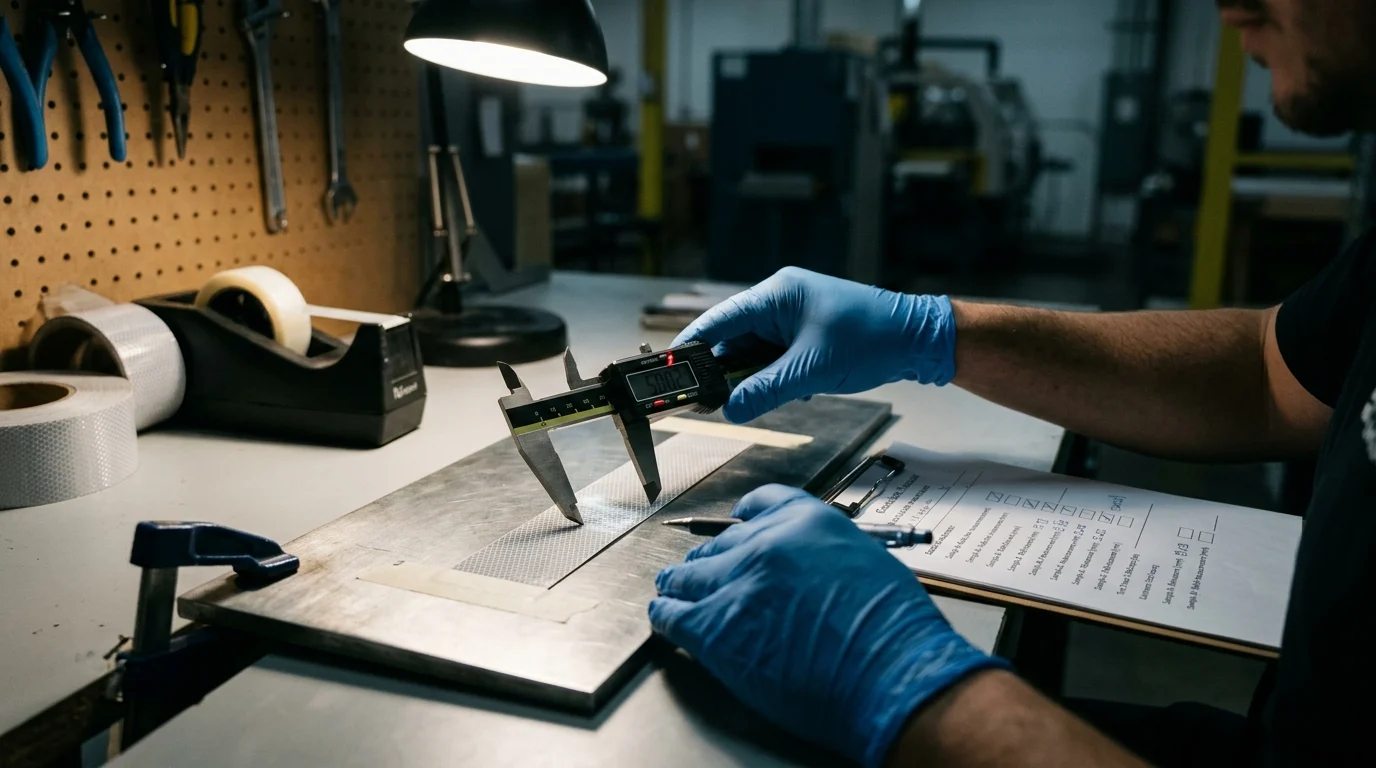
The life-saving capability of reflective materials relies on highly specialized engineering. Understanding the underlying technology, photometric performance metrics, and physical construction is essential for evaluating why certain tapes perform better in hazardous environments.
How retroreflective technology, brightness, and color affect performance
The core mechanism behind nighttime visibility is retroreflection. This is achieved through two primary technologies: exposed glass beads and microprismatic optics. Glass bead tape utilizes millions of microscopic, aluminum-coated glass spheres embedded in a fabric binder. When light strikes these spheres, it bends, bounces off the mirrored back, and returns to the source. Alternatively, microprismatic tape uses precise geometric vinyl prisms to reflect light, often yielding a brighter return at specific angles.
Performance is quantified by the coefficient of retroreflection (Ra), measured in candelas per lux per square meter (cd/lx/m²). Standard safety requirements typically mandate a minimum Ra of 330 cd/lx/m² for the initial state of the garment. Color also plays a role; while silver provides the highest photometric brightness (often exceeding 500 cd/lx/m²), colored reflective tapes (like yellow or orange) offer combined daytime fluorescence and nighttime reflectivity, though usually at a lower Ra value of around 200 to 250 cd/lx/m².
Which material and construction choices matter most
The backing material and bonding agents dictate the physical resilience of the tape. Standard tapes utilize a poly-cotton or 100% polyester backing, ideal for lightweight, breathable vests. However, industrial environments require specialized constructions. Flame-resistant (FR) tapes use an aramid backing (such as Nomex) to prevent melting or dripping when exposed to arc flashes or flash fires.
Another critical construction choice involves the application method. Sew-on tapes offer superior mechanical strength and are preferred for heavy workwear and turnout gear. Heat-transfer (iron-on) segmented tapes are increasingly popular for lightweight athletic-style workwear, as they flex with the fabric and eliminate rigid stitch lines, though they require strict temperature and pressure controls during garment manufacturing to prevent premature delamination.
How reflective tape types compare by use and durability
The choice between glass bead and microprismatic technologies, as well as their respective backings, directly impacts both the lifecycle and the optimal use case of the garment. Microprismatic tapes excel in severe weather, as their sealed surface prevents water from disrupting the optics. Glass bead tapes are favored for flexible apparel due to their drapability and wash resistance.
| Technology Type | Average Ra (cd/lx/m²) | Wash Durability (Standard) | Best Application |
|---|---|---|---|
| Standard Glass Bead | 400 – 500 | 25 – 50 cycles at 60°C | General construction vests, lightweight jackets |
| Premium FR Glass Bead | 400 – 450 | 50+ cycles at 60°C | Oil & gas coveralls, electrical utility wear |
| Microprismatic (Vinyl) | 500 – 700 | Wipe-clean / limited wash | Rainwear, high-speed highway traffic control |
How to Choose Reflective Tape for Different Jobs
Specifying the right visibility materials requires matching the physical properties of the tape to the environmental stressors of the jobsite. A one-size-fits-all approach often leads to premature garment failure or insufficient protection.
Which jobsite conditions shape tape selection
Jobsite conditions dictate the chemical, thermal, and mechanical resistance required from safety apparel. In the petrochemical and utility sectors, workers face flash fire and electrical arc hazards. Here, standard polyester tape is a severe liability, as it melts at approximately 250°C. Instead, FR-rated tapes tested to withstand temperatures up to 260°C for five minutes without degrading are mandatory.
Heavy abrasion environments, such as mining or masonry, quickly degrade exposed glass beads. In these settings, durability supersedes initial brightness. Tapes engineered with heavy-duty topcoats or specialized wash-resistant binders are necessary to maintain the minimum 330 cd/lx/m² reflectivity after exposure to harsh particulate matter and frequent industrial laundering.
When reflective tape outperforms other visibility measures
While active visibility measures like LED-equipped vests or portable light towers are useful, passive retroreflective materials remain the most reliable foundational safety layer. Active lighting requires power sources, introduces battery weight, and features electronic components prone to failure in wet or rugged conditions.
Reflective materials provide continuous, 360-degree visibility without maintenance or power requirements. Economically, integrating passive reflective tape costs between $0.50 and $3.00 per meter during garment production, whereas active LED systems can add $30 to $100 per garment. For large-scale workforce deployment, passive retroreflection offers an unmatched ratio of reliability to cost.
When higher-spec tape is worth the added cost
Investing in higher-specification tape is economically justified in environments with high vehicle speeds, complex visual backgrounds, or rigorous laundering requirements. A standard tape rated for 25 home wash cycles may fail within three months if subjected to industrial laundering, requiring the entire $40-$80 garment to be discarded.
Upgrading to a premium tape rated for 50 to 100 industrial wash cycles might increase the initial garment cost by $3 to $5, but it effectively doubles the usable lifecycle of the apparel. In high-traffic zones where vehicle speeds exceed 50 mph, the superior wide-angle reflectivity of premium microprismatic or high-index glass bead tapes provides the critical extra seconds of visibility that justify the upfront premium.
What to Check for Compliance and Quality
Procuring high-visibility apparel is heavily regulated. Organizations must navigate a complex matrix of international standards to ensure legal compliance, protect workers, and avoid costly liabilities associated with substandard personal protective equipment (PPE).
Which safety standards and garment requirements apply
The primary standards governing high-visibility apparel are ANSI/ISEA 107-2020 in the United States and EN ISO 20471 in Europe. These frameworks strictly define the minimum area of retroreflective material required based on the garment’s class. For example, an ANSI Class 2 garment requires a minimum of 0.13 square meters (201 square inches) of reflective tape, while a Class 3 garment requires 0.20 square meters (310 square inches).
Furthermore, these standards mandate the physical placement of the tape to outline the human form and require a minimum initial photometric performance of 330 cd/lx/m². They also stipulate that the tape must maintain a minimum reflectivity (often 100 cd/lx/m²) after a specified number of standardized wash cycles, ensuring the garment remains safe throughout its intended service life.
How to verify supplier quality and certification claims
The global PPE market is susceptible to counterfeit materials and exaggerated performance claims. Verifying supplier quality is paramount. Purchasers should demand current, independent third-party laboratory test reports validating that the specific tape model meets ANSI or EN ISO standards.
Quality assurance extends to the manufacturer’s facility. Suppliers operating under ISO 9001 quality management systems demonstrate a commitment to consistent batch-to-batch performance. When evaluating a new source for reflective tape, request physical samples to inspect for uniform bead distribution, strong backing adhesion, and legitimate certification watermarks or markings where applicable.
How to plan placement, maintenance, and replacement
Compliance is not static; it requires ongoing management. The placement of tape must utilize ‘biomotion’ principles—positioning reflective bands on moving joints like elbows, knees, and ankles. Research shows that highlighting human movement significantly accelerates a driver’s ability to recognize a pedestrian.
Maintenance protocols must strictly follow the manufacturer’s care instructions. Harsh alkalis, bleach, or excessive heat during laundering will strip the glass beads from the backing. Safety managers must implement a routine inspection program, establishing clear replacement thresholds. If a tape appears dull, cracked, or fails to reflect a flashlight beam effectively from 50 feet away, the garment must be retired immediately.
How to Make a Smarter Reflective Tape Investment
Optimizing a safety apparel program requires a strategic approach to procurement. By analyzing the total cost of ownership rather than just the initial purchase price, organizations can improve worker safety while controlling long-term budget expenditures.
How to balance price, compliance, and performance
Balancing price against compliance and performance requires categorizing tape investments based on the specific risk profile of the workforce. Over-specifying tape for indoor warehouse workers wastes capital, while under-specifying for highway crews invites catastrophic risk.
| Investment Tier | Avg. Price per 100m Roll | Compliance Suitability | Expected Lifespan (Wash Cycles) | Target Application |
|---|---|---|---|---|
| Economy / Standard | $25 – $40 | ANSI Class 1 & 2 | 25 Home Washes | Warehousing, delivery drivers, site visitors |
| Premium Industrial | $45 – $75 | ANSI Class 2 & 3 | 50+ Industrial Washes | Heavy construction, roadwork, mining |
| Specialty FR | $80 – $130 | NFPA 2112 / ANSI | 50+ Industrial Washes | Oil & gas, electrical utilities, welding |
Why a structured specification and trial process reduces risk
To mitigate the financial risk of adopting new safety materials, organizations should implement a structured specification and trial process. Before committing to a high-volume Minimum Order Quantity (MOQ)—which often starts at 1,000 to 3,000 meters for custom runs—safety managers should conduct a 30- to 60-day field trial.
During this trial, prototype garments should be distributed to workers in the most abrasive and demanding roles. Post-trial analysis must evaluate the tape for cracking, delamination, and retained reflectivity. This empirical data ensures that the chosen reflective materials not only meet laboratory compliance standards but also deliver proven, reliable visibility in the real-world conditions where they are needed most.
Further reading:
Key Takeaways
- The most important conclusions and rationale for reflective tape
- Specs, compliance, and risk checks worth validating before you commit
- Practical next steps and caveats readers can apply immediately
Frequently Asked Questions
How does reflective tape improve worker visibility at night?
It sends headlight beams back toward drivers, making workers stand out earlier. High-performance tape can extend detection distance to over 1,000 feet in suitable conditions.
What type of reflective tape is best for roadside or construction work?
Microprismatic tape is often best when maximum brightness is needed. For heavy-duty garments, choose sew-on options with durable backing suited to outdoor use.
Is colored reflective tape as bright as silver tape?
Usually no. Silver typically delivers the highest retroreflective brightness, while yellow or orange balances daytime visibility with lower nighttime performance.
Should I choose sew-on or heat-transfer reflective tape?
Use sew-on tape for rugged workwear and frequent washing. Choose heat-transfer segmented tape for lighter garments that need more flexibility and comfort.
Where can I compare reflective tape options on TramigoBlog?
Visit TramigoBlog’s product pages to compare reflective tape types, materials, and application styles. Match the tape to your garment, work environment, and visibility needs.


