
Zipper types directly influence durability, flexibility, weight, and environmental resistance in both apparel accessories and outdoor gear. The most widely used zipper types—metal zippers, coil (nylon) zippers, and molded plastic zippers—are engineered for different mechanical and environmental demands. In general, metal zippers deliver high mechanical strength, nylon coil zippers provide flexibility and lightweight performance, and molded plastic zippers balance corrosion resistance with moderate durability.
From a material engineering perspective, selecting between zipper types is not a cosmetic decision. It affects failure rate under stress, abrasion resistance in field conditions, and long-term usability in garments, backpacks, tents, and technical wear systems.
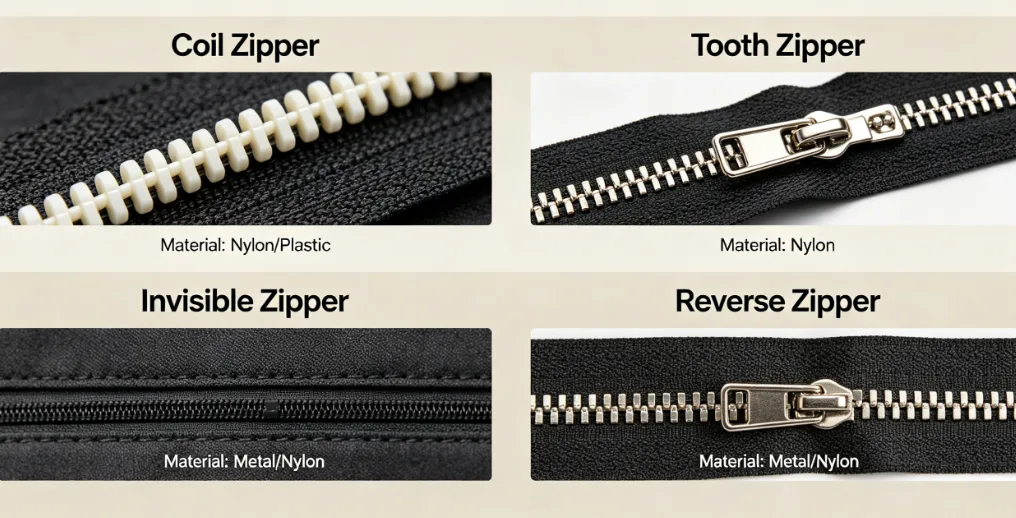
Overview of Zipper Types in Apparel Accessories and Outdoor Gear
Zipper types can be categorized based on tooth structure and material composition. In apparel accessories and outdoor gear design, three dominant systems are used: metal zippers, nylon coil zippers, and molded plastic zippers.
Metal Zippers in Apparel Accessories
Metal zippers are typically made from brass, nickel, or aluminum alloys. They are commonly used in denim, jackets, and heavy-duty bags due to their tensile strength and resistance to repeated mechanical load.
However, metal zippers are heavier and more prone to corrosion in high-moisture environments unless treated with protective coatings.
Nylon Coil Zippers in Outdoor Gear
Nylon coil zippers are constructed from polyester or nylon filament formed into a spiral coil. These are widely used in lightweight jackets, sleeping bags, and tents due to their flexibility and low weight.
They perform well in curved seams and are less likely to jam under fabric stress, making them a preferred choice in modern outdoor gear systems.
Explore nylon zipper solutions
Molded Plastic Zippers
Molded plastic zippers use injected plastic teeth molded directly onto the zipper tape. They are corrosion-resistant and moderately strong, often used in marine gear, backpacks, and protective apparel.
Metal vs Nylon Zipper: Structural and Functional Comparison
The choice between metal and nylon zipper systems is one of the most important engineering decisions in apparel accessories and outdoor gear development.
Metal zippers prioritize structural strength, while nylon coil zippers prioritize flexibility and weight efficiency. This difference determines where each zipper type performs best under real-world conditions.
| Feature | Metal Zipper | Nylon Coil Zipper |
|---|---|---|
|
Weight |
Higher due to alloy density |
Low, suitable for ultralight gear |
|
Flexibility |
Limited |
High, adapts to curved seams |
|
Corrosion resistance |
Medium (depends on coating) |
High |
|
Strength under load |
Very high |
Medium |
|
Repairability |
Moderate |
High |
In outdoor gear applications such as hiking backpacks and expedition jackets, nylon coil systems are preferred due to reduced friction and higher flexibility. In contrast, metal zippers remain dominant in apparel accessories requiring structural rigidity, such as denim jackets and leather goods.
View metal zipper components
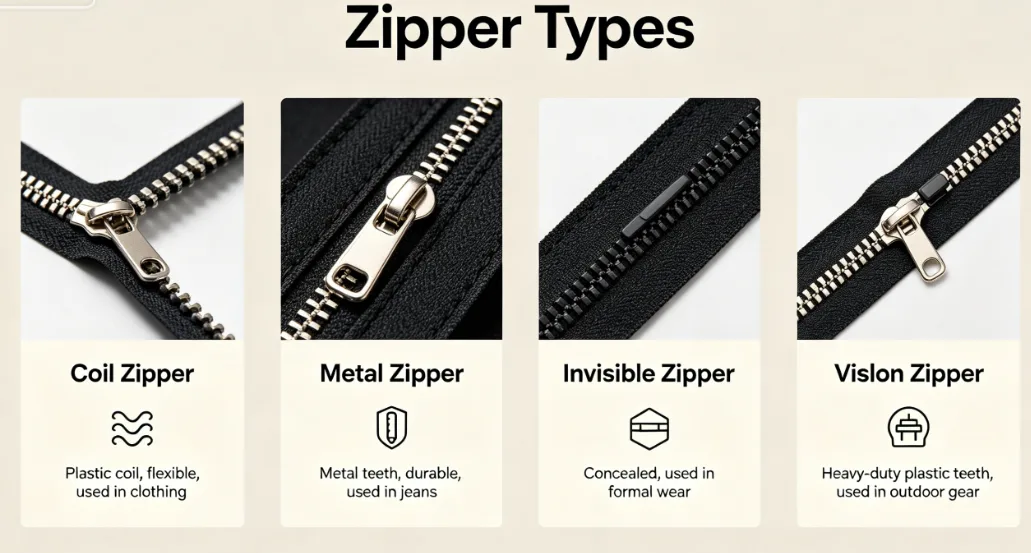
Zipper Types in Apparel Accessories: Functional Selection Criteria
In apparel accessories design, zipper types are selected based on garment structure, fashion requirements, and mechanical stress points.
Key selection parameters:
-
Fabric thickness compatibility
-
Expected mechanical load cycles
-
Aesthetic integration with garment design
-
Washing and chemical exposure resistance
Apparel application mapping
| Apparel Category | Recommended Zipper Type | Reason |
|---|---|---|
|
Denim jackets |
Metal zipper |
High tensile load resistance |
|
Lightweight jackets |
Nylon coil zipper |
Flexibility and comfort |
|
Dresses and skirts |
Nylon coil zipper |
Low visibility and smooth glide |
|
Leather apparel |
Metal zipper |
Structural alignment with heavy fabric |
Zipper types in apparel accessories must also comply with general textile safety and durability standards. Guidance from institutions such as the U.S. Consumer Product Safety Commission highlights the importance of mechanical reliability in wearable components. https://www.cpsc.gov
Zipper Types in Outdoor Gear: Environmental Performance Factors
Outdoor gear places higher demands on zipper systems due to exposure to moisture, temperature variation, UV radiation, and dust contamination.
Environmental performance considerations:
-
Water resistance and sealing capability
-
Freeze-thaw cycle stability
-
Dust and sand resistance
-
Long-cycle durability under load
Nylon coil zippers dominate in outdoor gear because they maintain flexibility under low temperatures and resist jamming caused by particulate intrusion. Molded plastic systems are often used in marine or wet environments where corrosion is a primary concern.
The National Institute of Standards and Technology (NIST) has published materials research frameworks that support understanding polymer performance under environmental stress conditions. https://www.nist.gov
Engineering Comparison of Zipper Types (Durability & Use Cases)
Zipper performance is strongly linked to material science properties defined by standards organizations such as ISO and ASTM.
| Property | Metal Zipper | Nylon Coil Zipper | Molded Plastic Zipper |
|---|---|---|---|
|
Abrasion resistance |
High |
Medium |
Medium |
|
Flex cycle life |
Medium |
High |
Medium |
|
Moisture resistance |
Low–Medium |
High |
High |
|
Weight efficiency |
Low |
High |
Medium |
|
Outdoor suitability |
Medium |
High |
High |
Standards frameworks from ISO and ASTM help manufacturers validate performance thresholds for textile fasteners and apparel components. https://www.iso.org https://www.astm.org
Energy-related materials testing environments also contribute to polymer performance validation under stress and temperature variation. https://www.energy.gov
Material Science Considerations in Zipper Types Selection
Zipper types selection is fundamentally a material engineering decision involving polymer chemistry and metal fatigue analysis. Nylon coil systems rely on thermoplastic elasticity, while metal systems rely on ductility and yield strength.
Key technical considerations include:
1.Elastic deformation tolerance in repeated cycles
2.Friction coefficient between slider and teeth
3.Thermal expansion behavior in outdoor environments
In apparel accessories engineering, balancing these variables ensures consistent performance across product life cycles. Textile testing methodologies often integrate environmental simulation chambers to evaluate zipper failure points under controlled conditions.
Internal Applications in Product Design Systems
Modern apparel and outdoor gear development integrates zipper systems into modular design platforms. Common implementation areas include:
Heavy-duty metal zipper systems for structured garments
-
Lightweight nylon zipper systems for performance apparel
-
Water-resistant zipper assemblies for outdoor gear
-
Custom zipper sliders and pulls for apparel accessories
-
Industrial-grade fastening systems for technical textiles
-
Reinforced outdoor gear closures for expedition equipment
These categories reflect how zipper types are integrated into broader apparel accessories ecosystems.
Key Conclusion: How to Select the Right Zipper Type
The selection of zipper types for apparel accessories and outdoor gear depends on a structured evaluation model:
1.Metal zippers are optimal for high-strength, low-flex applications.
2.Nylon coil zippers are optimal for lightweight, flexible, and outdoor-oriented systems.
3.Molded plastic zippers provide balanced performance in moisture-heavy environments.
Material selection should always align with environmental exposure, mechanical stress, and garment architecture rather than aesthetic preference alone.
FAQ: Zipper Types in Apparel Accessories and Outdoor Gear
1. What are the main zipper types used in apparel accessories and outdoor gear?
The primary zipper types include metal zippers, nylon coil zippers, and molded plastic zippers. Each type differs in strength, flexibility, and environmental resistance, making them suitable for different garment categories and outdoor applications.
2. How does a metal zipper differ from a nylon coil zipper in performance?
Metal zippers offer higher structural strength but lower flexibility and higher weight. Nylon coil zippers provide superior flexibility, lighter weight, and better resistance to jamming, making them more suitable for outdoor gear and performance apparel.
3. Which zipper types are best for waterproof outdoor gear?
Molded plastic and coated nylon coil zippers are commonly used in waterproof outdoor gear. Their resistance to corrosion and ability to integrate sealing structures make them suitable for wet and humid environments such as marine or hiking conditions.
4. What are common failure points in zipper types used in apparel accessories?
Common failure points include tooth misalignment in metal zippers, coil separation in nylon zippers, and stress cracking in molded plastic zippers. These issues are often related to material fatigue, improper load distribution, or environmental exposure.
5. Are zipper types standardized in manufacturing industries?
Yes, zipper types are evaluated under textile and material standards issued by organizations such as ASTM and ISO. These standards define testing methods for strength, durability, and environmental resistance to ensure consistency across apparel and outdoor gear applications.


